

Right-of-Way and Land Acquisition Services in Fort Collins and Northern Colorado: Supporting I-25 Expansion and the NoCo Growth Corridor
Right-of-way and land acquisition services in Fort Collins and Northern Colorado. How a Loveland-based ROW team handles I-25 expansion, NISP, Northern Water projects, and Larimer and Weld county acquisitions across the NoCo corridor.
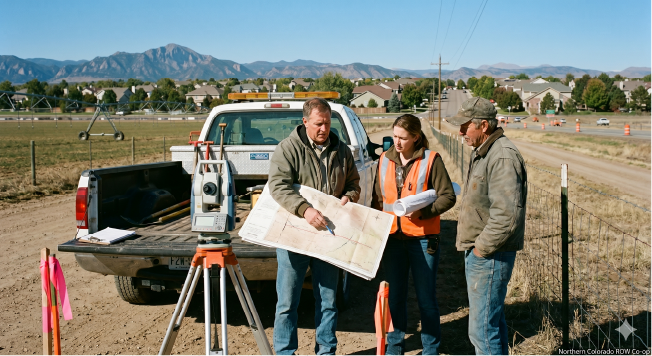
Northern Colorado is in the middle of one of the most active infrastructure cycles the region has ever seen. CDOT Region 4 is wrapping major segments of the I-25 North Express Lanes. Northern Water continues to advance the Northern Integrated Supply Project and Halligan-Seaman storage. Fort Collins is extending MAX bus rapid transit, and Larimer and Weld counties are working through the agricultural-to-residential transitions that the broader NoCo growth corridor is driving.
Western States Land Services is headquartered in Loveland — twelve miles south of Fort Collins, fifteen miles north of Longmont, in the middle of the corridor. Our agents are local. The county clerks know our people, the appraisers and counsel we work with are familiar names in Larimer and Weld, and we've been doing this work along the Front Range for more than 45 years. This page covers what right-of-way work in Fort Collins and Northern Colorado actually looks like.
Why right-of-way work in Northern Colorado requires local expertise
Northern Colorado isn't one market. It's a corridor running from Wellington and Fort Collins south through Loveland, Berthoud, and Longmont, with Greeley and the Weld County agricultural belt to the east and the Cache la Poudre and Big Thompson watersheds running through it. CDOT Region 4 governs the state highway program. Larimer and Weld counties have very different land-use patterns and recording practices. The City of Fort Collins, Loveland, Greeley, and a half-dozen smaller municipalities each manage their own ROW programs.
Water dominates the infrastructure conversation here in a way it doesn't anywhere else on the Front Range. Northern Water — operating the Colorado-Big Thompson Project — drives major capital work, including reservoir storage, transmission, and distribution. The Northern Integrated Supply Project (NISP) has been moving through federal and state review for years and is now into ROW execution on segments. Halligan-Seaman is in the planning pipeline. The Cache la Poudre and Big Thompson rivers shape any project that touches their corridors, and water rights questions complicate land acquisition in ways outside firms underestimate.
Beyond water, Weld County's place in the DJ Basin means severed minerals are a fact of life on most agricultural acquisitions. Wind farm tie-lines run through eastern Larimer, Weld, and Logan counties, with their own mix of fee, easement, and crossing arrangements. Anheuser-Busch and other industrial operators in Fort Collins and Loveland generate continuing utility expansion work. Colorado State University and the Cache la Poudre corridor add layers of municipal and conservation overlay. None of this is hard to navigate when you know the territory — and slow when you don't.
Right-of-way services Northern Colorado projects rely on
Each of the four core services shows up routinely on NoCo projects, often on the same corridor.
Right-of-way acquisition
I-25 expansion has been the highest-volume ROW work in NoCo for years. CDOT Region 4 has acquired fee strips at widened sections, partial fees at interchange reconfigurations, permanent drainage easements along the corridor, and temporary construction easements for the duration of the build. Express Lanes work involves substantial coordination with adjacent landowners — many of them long-time Larimer and Weld farmers and ranchers — and the relationships matter as much as the offer amounts.
Right-of-way acquisition for water infrastructure projects (NISP, Halligan-Seaman, Northern Water transmission improvements) typically runs on permanent easements with carefully drafted reservations for landowner use. Wind farm and solar tie-line acquisitions usually combine fee at the substation pad with permanent easements along the linear corridor. Subdivision and development-driven ROW dedications fill out the rest.
Title research and due diligence
NoCo title work has a few distinctive features. Larimer County records are well-organized but go back to early Colorado statehood; chain-of-title work on older agricultural parcels can pick up vintage water rights that affect what the surface owner can convey. Weld County's mineral history is dense: severed minerals tied to the DJ Basin appear on a substantial percentage of agricultural parcels, and active leases sit on top of many of them.
Title research and due diligence on Northern Colorado projects has to identify mineral severances, evaluate active leases, surface unrecorded use rights (prescriptive easements through neighboring fields are common), and resolve curative work on heirship, multi-owner, and trust-held parcels. Water rights run on a separate adjudication framework — they're not part of standard title work, but they intersect with land acquisition often enough that the team needs to know when to flag them.
Permitting and project management
NoCo permitting layers federal, state, and local frameworks routinely. CDOT Region 4 handles state highway permits. NISP, Halligan-Seaman, and similar major water projects pull in NEPA, USACE 404, ESA Section 7 (for Preble's meadow jumping mouse and other listed species), and Section 106 cultural resources reviews. Larimer and Weld counties each have their own grading, stormwater, and floodplain permit processes. Cities along the corridor add their own ROW permits and engineering reviews.
Permitting and project management for a NoCo project means tracking dependencies across all of these jurisdictions, building the critical path correctly, and managing the agency relationships that keep applications from sitting on someone's desk. A wind farm tie-line through eastern Larimer or Weld will routinely involve county, state, federal, and railroad coordination — sometimes all on a single corridor.
Uniform Act relocation assistance
Displacement on NoCo projects shows up most often on transportation widenings (I-25 expansion has displaced both residential and commercial properties in segments), water infrastructure projects that affect agricultural operations, and federally-funded transit work. The local housing market in Fort Collins and Loveland is tight enough that "comparable replacement housing" can require last-resort housing analysis. Agricultural displacements — a farm operation that has to relocate a head house, a livestock operation that has to find new pasture — require careful business-displacement analysis under Uniform Act relocation assistance.
Federal nexus is common. CDOT and FHWA funding, Northern Water's federal partners on C-BT, USDA Rural Development financing on broadband and water projects — all of these carry Uniform Act compliance obligations.
Recurring Northern Colorado project types
The NoCo work that recurs often enough to plan around:
I-25 North Express Lanes (CDOT Region 4). Continuing widening, interchange reconfigurations, frontage road improvements, and drainage work along the I-25 corridor from Loveland north through Fort Collins toward Wellington. Federal funding and Uniform Act compliance are the default.
Northern Water and water district capital projects. NISP segment acquisitions, Halligan-Seaman storage planning, transmission and distribution improvements across the C-BT system, water district expansion across Larimer, Weld, and surrounding counties. Permanent easements with detailed reservation language are the norm.
City of Fort Collins MAX BRT extensions and corridor work. MAX expansion, intersection upgrades, multimodal corridor improvements, utility relocations tied to redevelopment in the College Avenue corridor, and similar municipal infrastructure.
Wind and solar tie-line corridors. Renewable energy projects in eastern Larimer, Weld, and Logan counties continue to drive transmission and distribution ROW work, often with mineral, agricultural, and conservation overlays.
Industrial expansion infrastructure. Anheuser-Busch, Woodward, and other industrial operators in Fort Collins and Loveland generate continuing utility and access work. Subdivision and master-planned community infrastructure on the agricultural-to-residential edge of the corridor adds to the mix.
Telecom and broadband buildouts. Fiber installations under municipal, county, and state ROW, often covering long rural segments where the work is more about permits and coordination than about urban density.
How Western States supports Northern Colorado projects
We're headquartered in Loveland. That isn't a tagline — it's the operational reality. Our agents drive the corridor every day. Our title professionals know the Larimer County recorder in Fort Collins and the Weld County recorder in Greeley by name. We're CDOT-prequalified, federally compliant, and we've worked alongside Northern Water, CDOT Region 4, Fort Collins Utilities, and the smaller water districts and municipalities long enough to know how their programs run.
For projects that span the Continental Divide — a Northern Water transmission line that ties into trans-mountain diversion work, for example, or a wind farm tie-line that runs west into Routt or Moffat counties — our Grand Junction office anchors the Western Slope side of the work. We staff the project across both sides of the state without a handoff to a different firm.
We integrate ROW acquisition, title research, permitting, and Uniform Act relocation under one team. For NoCo projects, that means a single point of accountability from corridor selection through closing, and a team that already knows the agencies, the landowners, and the recurring patterns of Northern Colorado work.
Frequently asked questions
How is right-of-way being acquired for the I-25 North Express Lanes?
CDOT Region 4 manages the I-25 North program, with outside ROW firms handling field acquisition under CDOT supervision. The work follows Uniform Act standards because of federal funding, with appraisals, written offers at or above appraised value, and full Uniform Act documentation. Most parcels close through negotiation; a small number have moved through condemnation. The acquisition runs in segments matched to construction sequencing.
What's NISP and how does ROW for it work?
The Northern Integrated Supply Project is a major water supply project led by Northern Water that includes Glade Reservoir north of Fort Collins, additional storage at Galeton east of Greeley, and connecting pipelines and infrastructure. ROW acquisition for NISP involves permanent easements on the linear corridor, fee acquisition at reservoir sites, and substantial coordination with agricultural, residential, and conservation interests across Larimer and Weld counties. Federal review (NEPA, USACE 404) has been a significant driver of the project's overall timeline.
Are mineral rights a factor on Weld County acquisitions?
Almost always. Weld County sits over the DJ Basin, and severed minerals appear on most agricultural parcels. For surface ROW, the mineral severance can affect whether the project has secure rights against a future drilling operation. Identification of the mineral owner, evaluation of any active leases, and — where needed — negotiation of a non-disturbance or accommodation agreement is part of the work. Title research surfaces the severance; the project team works the practical consequences.
Does Fort Collins use eminent domain on city projects?
The City of Fort Collins has condemnation authority and uses it as a last resort. Most acquisitions close through negotiation. Where condemnation occurs, it's typically reserved for situations where genuine impasse exists despite documented good-faith negotiation. Larimer County and the smaller municipalities along the corridor operate similarly.
What permits does a developer need for new infrastructure in Larimer or Weld county?
The permit list depends on the project. New roadway dedications usually require county engineering review, stormwater and grading permits, and any applicable CDOT coordination for state highway connections. Utility infrastructure picks up state water quality permits, USACE 404 coverage if streams or wetlands are affected, and railroad coordination if alignment crosses BNSF or UP. Weld County's sage-grouse and prairie species habitat in eastern segments can pull in Section 7 ESA review on federally-nexused projects.
Can a Northern Colorado farm operation be displaced and stay in business?
Yes — the Uniform Act assumes most business operations, including farms, can relocate. Reestablishment expenses, moving expenses, and (in some cases) fixed payments based on net earnings are designed to support continuity. For farm operations with specialized equipment, livestock, or crop-cycle timing, careful documentation of search expenses and operational disruption costs makes a real difference in the outcome. Local relocation specialists who understand NoCo agricultural operations handle this work well.
Move your Northern Colorado project forward
Northern Colorado's infrastructure cycle isn't slowing down. The corridor needs ROW work that respects local landowners, follows federal and state law, and keeps complex multi-jurisdictional projects on schedule.
Western States Land Services has been doing this work from Loveland for more than 45 years. We handle right-of-way acquisition, title research and due diligence, permitting and project management, and Uniform Act relocation assistance — all integrated under one team, all grounded in current familiarity with Larimer, Weld, and the broader NoCo corridor.
For more on the broader process, see our complete guide to right-of-way acquisition. For a project on I-25, on the C-BT system, on a wind tie-line, or anywhere across Northern Colorado, start a conversation. We'll walk through your project and tell you what it will take to get the land rights you need.

Frequently Asked Questions
Have questions about our sustainability initiatives, eco-friendly practices, or how you can make a positive impact?
Western States Land Services is headquartered in Loveland, Colorado. We primarily serve Colorado, Wyoming, Nebraska, Kansas, New Mexico, Utah, and Texas, with experience working on projects across the broader Mountain West.
Western States Land Services was founded in 1981. The firm has been providing right-of-way acquisition, relocation, and permitting services in Colorado and the Mountain West for more than 45 years. Our team carries more than 150 years of combined industry experience.
Yes. Western States Land Services is prequalified with the Colorado Department of Transportation (CDOT) for right-of-way services. The firm is also experienced in FHWA requirements and fully compliant with the Uniform Relocation Assistance and Real Property Acquisitions Policies Act for federally regulated projects.
We serve public agencies, municipal governments, state departments of transportation, investor-owned utilities, oil and gas companies, pipeline operators, and private infrastructure developers. We have delivered right-of-way services across every sector — from CDOT highway corridors and utility transmission lines to rural pipeline routes and municipal capital improvement projects.
We offer the staffing capacity of a large firm with the direct access and personal accountability of a specialized boutique. Clients work with senior leadership — not a call center. Our agents meet landowners face-to-face. Our regulatory knowledge is deep rather than generalized. We have never needed to ramp up on Colorado or Mountain West rules. We have been working inside them for over 40 years.
Yes. Western States Land Services has experience supporting eminent domain proceedings, including preparing waiver valuations, providing expert witness testimony, and coordinating with legal counsel throughout the condemnation process. Our team has worked alongside attorneys on both agency-initiated and privately sponsored condemnation actions across Colorado.
