

The Complete Guide to Right-of-Way Acquisition for Infrastructure Projects in the Western U.S.
A practical guide to right-of-way acquisition for infrastructure projects in Colorado and the Mountain West — process, timelines, easements, the Uniform Act, and what keeps projects on schedule.
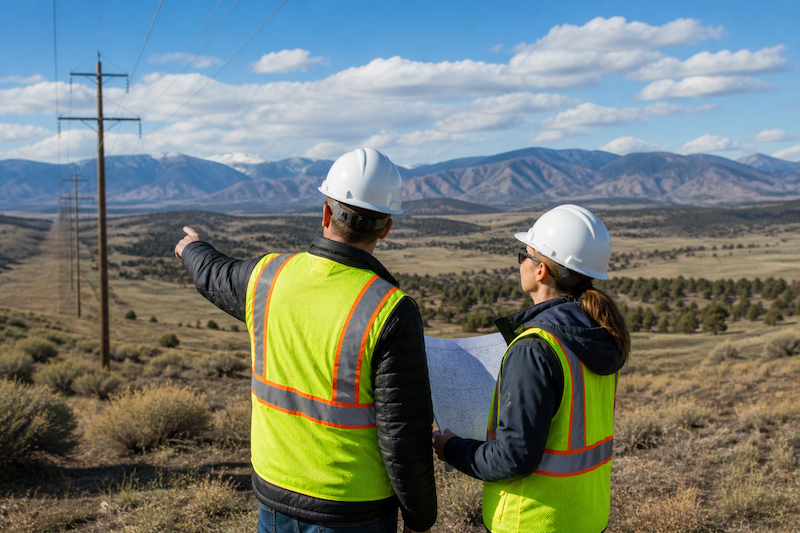
If your project crosses property you don't own, you need a right-of-way. That sounds simple. The work to get there is anything but.
Right-of-way acquisition is the legal and practical process of securing the land rights an infrastructure project needs to be built — whether that means buying property outright, negotiating an easement, or coordinating temporary access during construction. Done well, it keeps projects on schedule and out of court. Done poorly, it stalls timelines, drives up costs, and turns landowners into adversaries.
This guide walks through how right-of-way (often abbreviated ROW or RoW) acquisition actually works in the Western United States — the process, the players, the legal framework, and the decisions that separate smooth projects from the ones that bog down for years.
What is right-of-way acquisition?
Right-of-way acquisition is the process of securing legal rights to use, cross, or own private property for a public or infrastructure purpose. It applies any time a project — a highway widening, a transmission line, a pipeline, a fiber installation, a stormwater channel — needs to occupy or pass through land that someone else holds title to.
The "right-of-way" itself is a category of property interest. It can take several forms: outright ownership of a strip of land (called fee simple), a permanent easement that gives the project owner the right to use the land for a defined purpose, a temporary construction easement for the duration of the build, or some combination of all three.
For public projects, the process is governed by federal and state law. For private projects with public-utility status, similar rules often apply because of regulatory oversight and the eventual prospect of eminent domain. Either way, the process is paperwork-heavy, deadline-driven, and people-driven all at once.
Who needs right-of-way services?
Anyone building linear or distributed infrastructure on land they don't already control. In practice, that's a short list of project types and a long list of organizations:
Transportation agencies expanding highways, building interchanges, and improving rural roads. State DOTs like CDOT, county road and bridge departments, and federal agencies on FHWA-funded corridors all run continuous ROW acquisition programs.
Utility companies installing or upgrading electric transmission, distribution lines, natural gas pipelines, water and wastewater mains, and fiber-optic networks. Utility ROW often runs hundreds of miles and crosses dozens or hundreds of parcels.
Oil and gas operators building gathering systems, midstream pipelines, and compressor stations. Pipeline corridors usually require permanent easements with carefully defined surface rights.
Renewable energy developers connecting wind farms and solar arrays to the grid through generation tie-lines and substation expansions.
Municipalities and special districts handling water supply, drainage, sewer expansion, parks, and capital improvement projects.
Federal agencies and their contractors working across BLM, Forest Service, Bureau of Reclamation, and other public lands where permits and easements stack on top of each other.
If your project touches private land — or land managed by another government — you need ROW services.
The right-of-way acquisition process, step by step
Every project is different, but most acquisitions move through the same phases. Skipping or rushing any of them is where projects get into trouble.
1. Preliminary planning and corridor analysis
Before a single landowner is contacted, the project team identifies the corridor and the parcels involved. Engineering, environmental, and ROW staff work together to determine where the project must go and how wide the footprint needs to be. The goal at this stage is to minimize impacts and identify any parcels with unusual characteristics — heritage sites, conservation easements, mineral leases, or active operations that will complicate negotiation.
2. Title research and due diligence
Before approaching anyone, you need to know who actually owns the property and what other interests exist on it. Title research confirms ownership through the chain of title, identifies recorded easements and liens, flags mineral severances, and surfaces anything else that might affect the acquisition. Skipping this step is how projects discover, mid-build, that the "owner" they negotiated with didn't actually have authority to convey what they sold.
3. Appraisal and valuation
For federally-funded projects and most public projects, a certified appraisal is required before any offer is made. The appraisal establishes fair market value for the property interest being acquired — whether that's fee simple, an easement, or a combination — and considers any damages to the remainder property. The Uniform Act sets specific rules about how appraisals must be conducted and reviewed.
4. Initial offer and landowner contact
A ROW agent makes contact with the landowner, explains the project, presents the offer in writing, and walks through what's being acquired and how it affects the property. This is where face-to-face engagement matters more than anything else. A landowner who feels heard and respected at this stage is far more likely to negotiate in good faith than one who first hears about a project through a letter or a stake in the ground.
5. Negotiation
Most acquisitions are settled through negotiation, not litigation. The agent works with the landowner to address concerns — access, fencing, drainage, crop damage, restoration, timing — and to refine the offer where appropriate. Good ROW negotiation isn't a haggle over price. It's a structured conversation about what the project needs, what the landowner needs, and where there's room to align them.
6. Document execution and closing
Once terms are agreed, the parties execute the deed, easement, or other instruments. Documents are recorded with the appropriate county clerk and recorder. Payment is delivered. Funds may be escrowed where lien releases or other contingencies are involved.
7. Possession and construction
The project takes possession of the property interest and construction begins. The ROW team typically stays involved through construction to handle access issues, restoration disputes, and any post-acquisition coordination with landowners.
8. Post-construction follow-up
Restoration commitments are completed and signed off. Final payments tied to crop damage, fence replacement, or other deferred items are issued. Files are closed and archived for the project's permanent record.
A simple acquisition — a clear-title parcel, a willing seller, a routine easement — can move through these stages in a few weeks. A complex multi-parcel corridor with heirship issues, mineral conflicts, and condemnation cases will take many months and sometimes years.
Easements vs. fee simple acquisitions
One of the first decisions on any project is what kind of property interest to acquire. The two main options are fee simple and easement, and choosing correctly upfront saves money, time, and friction.
A fee simple acquisition is a full purchase of the property. The project owner takes title and the original landowner has no further interest in that land. Fee is appropriate when the project will permanently and exclusively occupy the area — for instance, where a new road centerline runs, or where a substation pad will sit.
A permanent easement gives the project owner the right to use the land for a specific, defined purpose while the original landowner retains ownership and most other rights. Easements are the right tool for buried pipelines, transmission corridors, and most utility installations, where the project owner needs surface access and subsurface rights but not full possession.
A temporary construction easement is exactly what it sounds like: a time-limited right to use additional land during construction for staging, access, or work space. It expires when construction is complete.
Choosing between fee and easement depends on the permanence of the use, the extent of surface impact, the cost differential, and what the landowner is willing to convey. Many corridor projects use a combination — fee at facility sites, permanent easements along the linear corridor, and temporary easements alongside for the build.
The Uniform Act and why it matters
If your project receives any federal funding — and most public infrastructure does — the Uniform Relocation Assistance and Real Property Acquisition Policies Act of 1970 governs how you acquire property and how you treat people displaced by the project.
The Uniform Act (often called the URA) establishes minimum standards designed to ensure fair and consistent treatment of property owners and tenants. It requires:
A written offer based on an approved appraisal, with the offer at or above appraised value.
A reasonable opportunity for the owner to consider the offer and have it reviewed.
Relocation assistance — including advisory services, moving expenses, and replacement housing payments — for residents and businesses displaced by the project.
Documentation throughout the process, including written explanations of how just compensation was determined.
A right to negotiate and, where applicable, a right to administrative review.
URA compliance isn't optional. Failing to follow it can result in funding clawbacks, project delays, and legal exposure. For projects involving displaced households or businesses, Uniform Act-compliant relocation services are essential, not optional.
Eminent domain: a last resort, not a strategy
Eminent domain — the legal authority to compel property transfer in exchange for just compensation — exists for a reason. Some acquisitions can't be settled through negotiation, and the law recognizes that infrastructure of public benefit shouldn't be held hostage by a single holdout.
But experienced ROW teams treat eminent domain as a last resort, not an opening move. Condemnation is expensive, time-consuming, and adversarial. It also damages the project's reputation in the community, which matters because most projects need to negotiate with the same people again later — for adjoining parcels, future expansions, or unrelated work.
Good ROW practice resolves more than 95% of acquisitions through voluntary negotiation. Condemnation should be reserved for the small number of cases where, despite genuine efforts, agreement isn't possible.
Timelines and what drives them
Project managers always want to know how long ROW will take. The honest answer: it depends. The factors that drive ROW timelines are:
Number of parcels — more parcels mean more parallel negotiations, more title work, more documents, and more variability.
Complexity of ownership — heirship properties, properties held in trusts or LLCs, absentee owners, and mineral severances all add weeks or months.
Project type and footprint — fee acquisitions take longer to value and close than easements; corridor projects with hundreds of parcels need staged work plans.
Funding source — federally funded projects must follow the Uniform Act, which has prescribed waiting periods and documentation requirements.
Environmental and permitting overlap — ROW often can't be finalized until NEPA documents are complete, and permits can dictate how the corridor can be used.
Landowner cooperation — willing sellers move quickly; complex landowners with legitimate concerns require time and patience.
A well-staffed ROW program can typically close routine parcels in 60 to 120 days. Complex or contested parcels can take six months to two years. Building a realistic schedule from the start — and giving ROW the lead time it needs — is one of the most consequential decisions a project manager makes.
What to look for in a right-of-way firm
ROW work blends law, negotiation, real estate, project management, and field operations. The firms that do it well share a few characteristics:
Regional expertise. Land law, agency procedures, and even cultural expectations vary state by state and county by county. A firm that's worked in Colorado, Wyoming, and the broader Mountain West knows how CDOT runs its program, how a Boulder County clerk records documents, and how a Routt County rancher prefers to be approached.
Federal compliance experience. If your project is federally funded, you need a team fluent in the Uniform Act, FHWA procedures, and the documentation standards that come with them.
Bench depth without bureaucracy. Large enough to staff multi-phase projects with senior agents, small enough that the principals are involved in your work — that's the sweet spot.
A network of specialists. Title companies, appraisers, surveyors, attorneys, environmental consultants. ROW is a team sport. Your firm should bring its bench to your project.
Track record on similar projects. Highway expansions, utility corridors, pipeline projects, and municipal acquisitions are different disciplines. Experience on the type of project you're building matters more than total years in the industry.
Frequently asked questions
What's the difference between a right-of-way and an easement?
A right-of-way is the broader category — the legal right to use land for transit or transport. An easement is one form of right-of-way: a defined, recorded right to use a piece of property for a specific purpose. In practice, the terms overlap heavily, and a "right-of-way" is often acquired as an easement.
Can I refuse to sell my property to a public agency?
You can refuse a specific offer, and you can negotiate. If the project has eminent domain authority, the agency can ultimately compel the transfer through condemnation, but you have a constitutional right to just compensation and to challenge the valuation in court.
How is "fair market value" determined?
A certified appraiser estimates value based on comparable sales, the property's highest and best use, and any damages to the remainder. For federally funded projects, the appraisal must follow Uniform Act standards and be reviewed before any offer is made.
Are temporary construction easements paid separately?
Yes. Temporary easements are a separate property interest with their own value, typically calculated based on the rental value of the area for the construction period plus any damages. They're paid in addition to permanent easements or fee acquisitions on the same parcel.
What happens if I disagree with the appraised value?
You can negotiate. You can also obtain your own appraisal — and the project may reimburse a portion of that cost under the Uniform Act. If agreement still isn't possible, the matter goes to administrative review or, ultimately, court.
Do I have to allow access to my property for surveys before agreeing to sell?
Most states allow project teams to enter property for surveys, environmental studies, and similar pre-acquisition work, often with notice requirements. Specific rules vary by state.
Where Western States works in Colorado and the Mountain West
Geography matters in right-of-way work. Front Range projects move through different counties, recorder's offices, and political environments than Western Slope projects do. A highway widening through Aurora is a different animal than a transmission corridor across Mesa County. Our Loveland headquarters covers the Front Range from Cheyenne to Pueblo — Larimer, Weld, Boulder, Adams, Arapahoe, Denver, Douglas, El Paso counties — and our Grand Junction office anchors our Western Slope work across Mesa, Garfield, Rio Blanco, Moffat, Montrose, and Delta counties. Together they let us staff projects across Colorado, Wyoming, Nebraska, Kansas, New Mexico, Utah, and Texas without losing the local familiarity that good ROW work depends on.
Beyond right-of-way acquisition, our team also handles title research and due diligence, permitting and project management, and Uniform Act-compliant relocation assistance — so a single integrated team can carry a project from corridor selection through closing.
Move your project forward with the right ROW partner
Right-of-way acquisition isn't paperwork. It's the connective tissue between a project on paper and a project on the ground. The firms that do it well respect landowners, follow the law, and keep the project moving.
Western States Land Services has spent more than 45 years acquiring right-of-way for highways, utilities, pipelines, and municipal projects across Colorado and the Mountain West. We are CDOT-prequalified, federally compliant, and built around the kind of face-to-face landowner engagement that keeps projects on schedule — whether the work is on the Front Range, the Western Slope, or anywhere in between.
If you have a project on the horizon — or one that's stalled and needs to get moving — start a conversation. We'll walk through your project and tell you, candidly, what it will take to get the land rights you need.
Frequently Asked Questions
Have questions about our sustainability initiatives, eco-friendly practices, or how you can make a positive impact?
Western States Land Services is headquartered in Loveland, Colorado. We primarily serve Colorado, Wyoming, Nebraska, Kansas, New Mexico, Utah, and Texas, with experience working on projects across the broader Mountain West.
Western States Land Services was founded in 1981. The firm has been providing right-of-way acquisition, relocation, and permitting services in Colorado and the Mountain West for more than 45 years. Our team carries more than 150 years of combined industry experience.
Yes. Western States Land Services is prequalified with the Colorado Department of Transportation (CDOT) for right-of-way services. The firm is also experienced in FHWA requirements and fully compliant with the Uniform Relocation Assistance and Real Property Acquisitions Policies Act for federally regulated projects.
We serve public agencies, municipal governments, state departments of transportation, investor-owned utilities, oil and gas companies, pipeline operators, and private infrastructure developers. We have delivered right-of-way services across every sector — from CDOT highway corridors and utility transmission lines to rural pipeline routes and municipal capital improvement projects.
We offer the staffing capacity of a large firm with the direct access and personal accountability of a specialized boutique. Clients work with senior leadership — not a call center. Our agents meet landowners face-to-face. Our regulatory knowledge is deep rather than generalized. We have never needed to ramp up on Colorado or Mountain West rules. We have been working inside them for over 40 years.
Yes. Western States Land Services has experience supporting eminent domain proceedings, including preparing waiver valuations, providing expert witness testimony, and coordinating with legal counsel throughout the condemnation process. Our team has worked alongside attorneys on both agency-initiated and privately sponsored condemnation actions across Colorado.
