

Right-of-Way and Land Acquisition Services in Denver, Colorado: Acquiring Land Rights for Front Range Infrastructure
Right-of-way and land acquisition services in Denver, Colorado. How experienced ROW agents secure easements, fee parcels, and Uniform Act displacements for CDOT, RTD, Denver Water, Xcel, and private infrastructure across the Front Range.
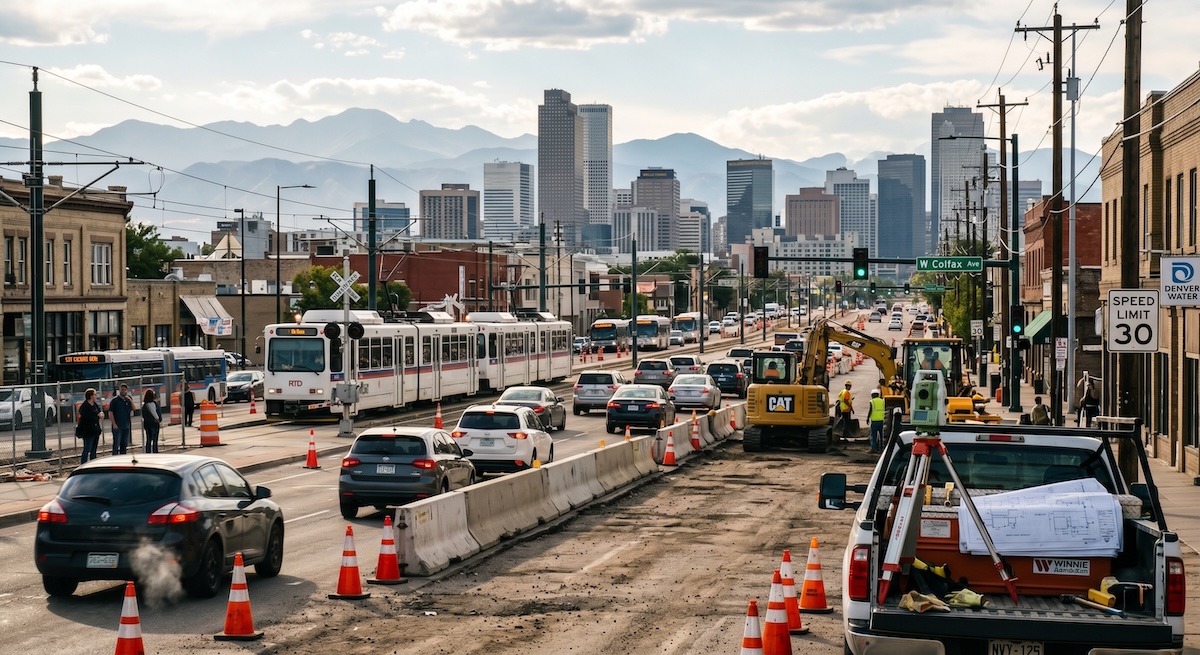
Right-of-way work in Denver isn't the same job it is anywhere else in Colorado. The corridors are tighter, the title work is denser, the displacement exposure is higher, and on most projects the agencies on the other side of the table have done this dance before. A Denver project that ignores the local rhythm — county recorder by county recorder, agency by agency — usually runs late.
Western States Land Services has been acquiring right-of-way for transportation, utility, and municipal projects across the Front Range for more than 45 years. Our Loveland headquarters is an hour up I-25, close enough that our agents are in Denver City and County Building, the Adams County clerk's office, or an Arapahoe County kitchen table on most working days. This page covers what right-of-way work in Denver actually involves and how to get it done cleanly.
Why right-of-way work in Denver requires local expertise
Denver Metro is a layered jurisdictional environment. A single corridor project can run through the City and County of Denver, then into Adams, then into Arapahoe, then into Jefferson — each with its own clerk and recorder, its own grading and stormwater rules, its own ROW permit form, and its own pace. CDOT Region 1 governs the state highway crossings. RTD owns and operates light rail and bus rapid transit corridors that intersect with most major projects. Denver Water, Denver Wastewater Management, and Xcel Energy run their own utility frameworks alongside everything else.
The ground itself adds difficulty. Urban infill is the dominant pattern: projects squeezing through long-platted neighborhoods where parcel lines, alley dedications, and 1880s-era easements all carry forward. Cherry Creek and the South Platte drainages cut diagonally across the grid and complicate any project that has to follow them. Class I railroads — BNSF and Union Pacific both run heavy traffic through downtown — set their own crossing standards and review timelines. None of this is impossible, but every piece of it takes practiced hands.
Eminent domain in Denver isn't theoretical. The City and County of Denver, RTD, CDOT, and several special districts all have condemnation authority and use it when negotiations stall. Most acquisitions still close voluntarily — a healthy program clears more than 95 percent of parcels through negotiation — but the legal posture matters from the first conversation.
Right-of-way services Denver projects rely on
A Denver project usually needs every piece of a full ROW program working at once. Here's how each service shows up in practice.
Right-of-way acquisition
Most Denver corridor work involves a mix of fee acquisitions and easements. Highway widenings on I-25 Central or the I-70 East corridor pick up fee centerline strips, partial fee at interchange ramps, and permanent drainage easements. RTD light rail extensions take fee where the alignment runs at-grade and easements where the structure passes over existing ROW. Utility projects — Denver Water mains, Xcel transmission and distribution, fiber installs — generally run on permanent easements with temporary construction easements alongside.
Right-of-way acquisition in Denver is paperwork-heavy. Multiple owners on a single deed are common in older neighborhoods. LLC ownership has become the norm in commercial corridors. Title insurance commitments routinely turn up easements from the 1920s that the project has to either honor or release.
Title research and due diligence
Denver title work goes deep. The City and County of Denver clerk and recorder holds documents back to territorial days, and the records can be harder to navigate than newer suburban counties. Older Curtis Park, Five Points, and Whittier parcels carry subdivision plats from the 1880s with vacated alleys, dedicated rights-of-way that may or may not have been formally relinquished, and chain-of-title issues from generations of family transfers.
Title research and due diligence for Denver projects has to surface every recorded interest, identify any unrecorded interests through field investigation, and resolve curative work before the project relies on a closing. Mineral severances are less common in Denver proper than on the Eastern Plains, but they do appear — particularly at the edges of Adams and Arapahoe counties.
Permitting and project management
Denver layered permitting is its own discipline. A single utility crossing might require a Denver Public Works ROW permit, a CDOT access permit, an RTD coordination agreement, and a railroad crossing license — plus a USACE 404 if the work touches Cherry Creek or the Platte. Permitting and project management on a Denver project means tracking the dependencies, building the critical path, and meeting in person with the agencies whose schedules drive the work.
Denver International Airport airspace adds another layer for any project tall enough to trigger FAA Form 7460 review. RTD coordination is usually a constraint, not an option. Watershed coordination — Cherry Creek, Chatfield, the South Platte — runs through the Denver-area water quality framework that's specific to this region.
Uniform Act relocation assistance
Denver Metro displacement is a real and recurring part of ROW work here. Older Denver neighborhoods — particularly rental stock in West Denver, parts of Globeville and Elyria-Swansea, sections of Aurora's western edge — frequently face displacement when CDOT widens a corridor or RTD extends a line. The local rental market makes "comparable replacement housing" hard to find within standard payment caps, which means more cases need last-resort housing analysis and documentation.
Uniform Act relocation assistance on a Denver project requires advisory services from specialists who know the local housing inventory, the property management firms, the social service agencies, and the practical realities of helping a displaced family find replacement housing in a tight market. Generic relocation services don't work here. The work has to be local.
Recurring Denver project types
A few project categories recur often enough to be worth naming directly.
CDOT Region 1 corridor projects. I-25 Central improvements, I-70 East work, U.S. 6 and U.S. 285 modifications. Each runs through dense urban ROW with high-value parcels and significant displacement exposure. Federal funding usually means full Uniform Act compliance.
RTD light rail and BRT extensions. RTD's continuing buildout — extensions, station improvements, intermodal facility additions — drives steady ROW work across Denver, Aurora, Lakewood, and the inner suburbs. RTD has its own ROW staff and procedures, and projects move through their framework rather than around it.
Denver Water and Denver Wastewater Management projects. Treatment plant expansions, transmission main replacements, drainage and stormwater work along Cherry Creek and the Platte. These projects often involve permanent easements through residential neighborhoods and temporary disruptions that require careful landowner communication.
Xcel Energy and telecom utility installations. Distribution upgrades, transmission line additions, fiber buildouts. Utility easements stack on top of older utility easements, and resolving the conflicts is half the work.
Private development infrastructure. Subdivision-driven roadway extensions, master-planned community utility tie-ins, redevelopment projects on former industrial sites. These pull in the same disciplines but run on developer schedules, which compresses everything.
How Western States supports Denver projects
We bring 45+ years of right-of-way experience across Colorado and the Mountain West, with current CDOT prequalification and a track record on federally-funded corridor work. Our Loveland headquarters covers the Front Range from Cheyenne to Pueblo, including Denver Metro and the surrounding counties. Our Grand Junction office anchors our Western Slope work for projects that cross the divide.
Our agents know the Denver clerk's office, the RTD ROW staff, the CDOT Region 1 right-of-way unit, and the title professionals, surveyors, and counsel who do recurring work in this market. We integrate ROW acquisition, title research, permitting, and Uniform Act relocation under one team — so a Denver project gets a single point of accountability rather than a coordinated handoff between firms.
For federally-funded projects, we run on Uniform Act standards from day one. For private projects with utility status, we apply the same discipline because most of those projects ultimately face the same regulatory scrutiny. Either way, the work is professional, documented, and respectful of the people whose property is in the corridor.
Frequently asked questions
How long does right-of-way acquisition take in Denver?
For a clean parcel with a willing seller and no title issues, 60 to 90 days from initial contact to closing is typical. For older Denver neighborhoods with chain-of-title problems, multiple owners, or displacement implications, six months is more realistic. Major corridor projects with hundreds of parcels usually run on a 12- to 24-month acquisition schedule, with the most difficult parcels stretching beyond that.
Does the City and County of Denver use eminent domain?
Yes. Denver, RTD, CDOT, and several special districts in Denver Metro all have condemnation authority and use it when negotiations genuinely cannot be resolved. That said, condemnation is a last resort. A well-run program in Denver closes more than 95 percent of parcels through voluntary negotiation, with eminent domain reserved for the small number of cases where impasse is real.
What's the difference between an easement and a fee acquisition in Denver?
A fee acquisition transfers full ownership of the property to the project. An easement gives the project specific use rights while the original owner keeps title. In Denver, fee is typical for road centerlines, RTD light rail alignments, and substation pads; easements are typical for utility runs, drainage corridors, and shared-use ROW. Most corridor projects use a mix of both.
Who handles right-of-way acquisition for the City and County of Denver?
Denver Public Works manages the city's own ROW program, and RTD handles transit corridors. CDOT Region 1 manages state highway projects. Most major projects also retain outside ROW firms — like Western States — to staff field acquisition, run title research, and handle Uniform Act compliance. The agency stays involved at the program level; the firm carries the work parcel by parcel.
How do I get a permit to install a utility line in Denver right-of-way?
Utility installation in Denver public ROW requires a Denver Public Works permit, often combined with a city engineering review, plus any railroad or CDOT coordination if the alignment crosses those jurisdictions. The permit application has technical and insurance requirements that vary by project type. A pre-application meeting with Denver Public Works staff almost always shortens the actual review timeline.
What does Uniform Act relocation look like in Denver?
For residential displacements, the Uniform Act requires advisory services and replacement housing payments calibrated to local market conditions. In Denver's housing market, that often means last-resort housing payments above the standard cap, with documentation supporting every dollar. For business displacements, the Act provides moving expenses, reestablishment costs, and search expenses — all calculated on the actual conditions facing the displaced operation.
Move your Denver project forward
Right-of-way work in Denver isn't a paperwork exercise. It's the connective tissue between project plans and project delivery — and on the Front Range, the firms that do it well respect both the timeline and the people whose property is in the corridor.
Western States Land Services brings the experience, the bench, and the Front Range presence to staff Denver projects from corridor selection through closing. We handle right-of-way acquisition, title research and due diligence, permitting and project management, and Uniform Act relocation assistance under one roof — so your project moves on a schedule we can stand behind.
For more on the broader process, start with our complete guide to right-of-way acquisition. When you're ready to talk through a Denver project — in planning, stalled, or just on the horizon — start a conversation. We'll give you a candid read on what the work will take.
Frequently Asked Questions
Have questions about our sustainability initiatives, eco-friendly practices, or how you can make a positive impact?
Western States Land Services is headquartered in Loveland, Colorado. We primarily serve Colorado, Wyoming, Nebraska, Kansas, New Mexico, Utah, and Texas, with experience working on projects across the broader Mountain West.
Western States Land Services was founded in 1981. The firm has been providing right-of-way acquisition, relocation, and permitting services in Colorado and the Mountain West for more than 45 years. Our team carries more than 150 years of combined industry experience.
Yes. Western States Land Services is prequalified with the Colorado Department of Transportation (CDOT) for right-of-way services. The firm is also experienced in FHWA requirements and fully compliant with the Uniform Relocation Assistance and Real Property Acquisitions Policies Act for federally regulated projects.
We serve public agencies, municipal governments, state departments of transportation, investor-owned utilities, oil and gas companies, pipeline operators, and private infrastructure developers. We have delivered right-of-way services across every sector — from CDOT highway corridors and utility transmission lines to rural pipeline routes and municipal capital improvement projects.
We offer the staffing capacity of a large firm with the direct access and personal accountability of a specialized boutique. Clients work with senior leadership — not a call center. Our agents meet landowners face-to-face. Our regulatory knowledge is deep rather than generalized. We have never needed to ramp up on Colorado or Mountain West rules. We have been working inside them for over 40 years.
Yes. Western States Land Services has experience supporting eminent domain proceedings, including preparing waiver valuations, providing expert witness testimony, and coordinating with legal counsel throughout the condemnation process. Our team has worked alongside attorneys on both agency-initiated and privately sponsored condemnation actions across Colorado.
