

Infrastructure Permitting in the Western U.S.: A Project Manager's Roadmap from Application to Approval
A practical roadmap for permitting infrastructure projects in the Western U.S. — federal, state, and local permits, sequencing, agency coordination, and how to keep schedules from slipping.
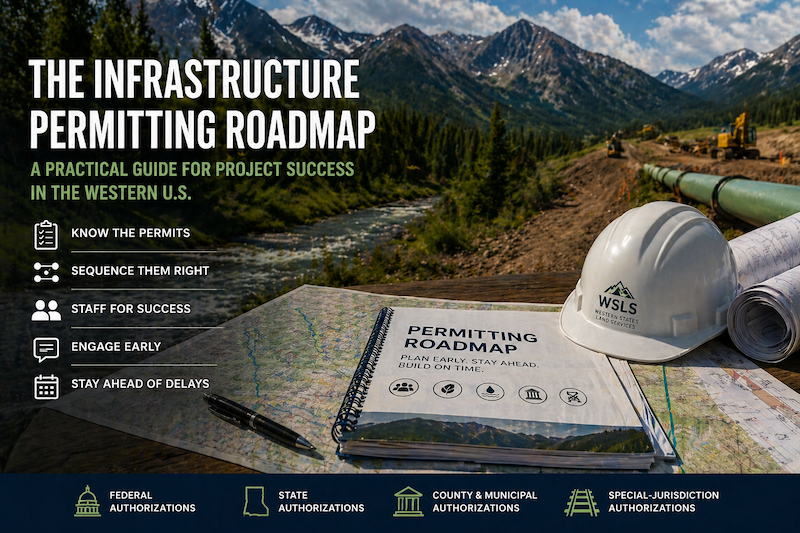
Permits don't usually break a project. Permitting does.
A single permit, applied for early and worked through cleanly, rarely causes problems. A stack of permits — federal, state, county, municipal, special district, railroad, utility — applied for late, in the wrong sequence, with incomplete applications and weak agency coordination, can quietly add a year to a schedule and millions to a budget.
This article lays out a practical roadmap for permitting infrastructure projects in the Western U.S. It covers the major permit categories, how they sequence, how to staff for the work, and how to avoid the recurring failure modes that put project schedules in trouble.
What does "infrastructure permitting" actually cover?
Permitting is the process of obtaining the legal authorizations a project needs to be built and operated. For most infrastructure projects in the West, that includes some combination of:
Federal authorizations — NEPA reviews, USACE 404 permits for waters and wetlands, Endangered Species Act consultations, Section 106 cultural resource reviews, BLM and Forest Service rights-of-way, FAA notices, FERC certificates for interstate gas pipelines, USFWS coordination on migratory birds and listed species.
State authorizations — water quality certifications, air quality permits, state SHPO and historical preservation reviews, state DOT crossing permits, state utility commission approvals.
County and municipal authorizations — local building permits, grading and stormwater permits, road crossing permits, floodplain permits, special use approvals, zoning variances, public works approvals.
Special-jurisdiction authorizations — railroad crossing licenses (BNSF, UP, etc.), other utility crossing agreements, irrigation district approvals, conservation district reviews, drainage district permits.
That's an outline. For any specific project, the actual permit list depends on what the project is, where it goes, what it crosses, and how it's funded.
Why permitting is harder than it looks
A few features of permitting consistently catch project teams off guard:
Permits don't sequence themselves. Many permits depend on other permits. NEPA can't close until consultations are done. A county grading permit may require state water quality certification first. A USACE 404 permit may depend on Section 106 review. The dependency map matters more than the individual permit timelines, because the slowest path through the dependency map is the actual schedule.
Agencies have their own clocks. Each agency operates on its own pace, and that pace usually isn't aligned with the project's. A 30-day review can take 90 in practice. Pushing back doesn't speed it up; preparing well does.
Incomplete applications get rejected, not improved. A submitted-but-deficient application is often worse than no application at all. Many agencies will return incomplete applications with a clean list of issues to fix and start the clock again from scratch when you resubmit.
Field changes trigger re-reviews. A construction-driven decision to shift an alignment a few hundred feet can trigger re-review under multiple permits. Build the assumption into the schedule that field changes happen and that re-reviews will follow some of them.
Public engagement is part of permitting. Some authorizations require public notice and comment periods. Public engagement done well shortens permit timelines; done poorly, it generates comments and contests that extend them.
The teams that handle all of this well treat permitting as project management, not paperwork. The work is half technical and half scheduling.
The major permit categories, in plain English
A practical guide to the categories that most often govern western infrastructure work:
NEPA: the federal environmental review
The National Environmental Policy Act applies whenever a project involves federal funding, federal permits, or federal land. Three levels of review exist — categorical exclusion, environmental assessment (EA), and environmental impact statement (EIS) — and the project's depth of review depends on its likely environmental impact.
NEPA isn't itself a permit. It's an umbrella process that organizes the federal review. Many federal permits, including USACE Section 404 permits and BLM rights-of-way, can't be issued until NEPA is complete.
NEPA timelines vary widely. A categorical exclusion may take a few weeks; an EA, several months; a full EIS, two years or more. Plan accordingly.
USACE Section 404: waters and wetlands
The U.S. Army Corps of Engineers regulates discharge of dredged or fill material into waters of the United States, including most wetlands. Anything that crosses a stream, drainage, wetland, or pond is in 404 territory.
Most linear infrastructure work goes through Nationwide Permits — pre-issued general permits that cover specific activity types with limited individual review. NWP 12 (utility line activities) is the workhorse for pipeline and utility projects. Where impacts exceed nationwide thresholds, an Individual Permit is required, with substantially more involved review.
Section 401 water quality certification from the state runs alongside the 404 permit and has to be coordinated with it.
Endangered Species Act consultation
Where a federal nexus exists and listed species or critical habitat are present, Section 7 consultation with the U.S. Fish and Wildlife Service or NOAA Fisheries is required. Consultation outcomes drive avoidance, minimization, and sometimes mitigation requirements that can affect alignment, construction methods, and timing.
For non-federal projects with potential to affect listed species, Section 10 (incidental take) authorizations may be appropriate.
Section 106 cultural resources review
Where a federal nexus exists, the National Historic Preservation Act requires consultation with the State Historic Preservation Office (SHPO) and other parties about effects on historic properties. Section 106 reviews often involve archaeological surveys, evaluations of eligibility for the National Register, and mitigation agreements when avoidance isn't possible.
BLM and USFS rights-of-way
Projects crossing federal land managed by the BLM or Forest Service require a Title V right-of-way grant (BLM) or Special Use Permit (USFS). These authorizations involve their own NEPA review, agency-specific application requirements, and rent or cost-recovery payments.
Federal land permitting is its own discipline. Project schedules need to allow real time for it.
Railroad crossings
Crossing a railroad ROW requires a license or pipeline crossing agreement from the railroad. The major Class I railroads — BNSF and Union Pacific in the West — have detailed application procedures, technical standards, and review timelines. Railroad permitting is often a critical path constraint on linear projects.
State and local permits
State and local permitting varies by state and jurisdiction. Common categories:
State DOT permits for crossings, encroachments, or work in state highway ROW.
State water quality and stormwater permits.
State utility commission approvals for utility infrastructure.
County grading, stormwater, and floodplain permits.
Municipal building, zoning, and right-of-way permits.
Special district permits — irrigation, drainage, conservation, fire protection.
The lower the level of government, the more variable the requirements. A county that handles a few utility projects per year may have a different process every time. Engaging local agencies early, in person, is the most reliable way to understand what they actually need.
Sequencing: the part most teams underestimate
The permit dependency map is where projects get into trouble. A few examples of how dependencies actually run:
A USACE 404 permit can't issue without state 401 water quality certification.
State 401 certification requires application materials that depend on the same engineering and environmental work as the 404 application.
If the project has a federal nexus, NEPA needs to be complete or near-complete before federal permits issue.
NEPA depends on Section 7 ESA consultation and Section 106 cultural resources review, which depend on biological and cultural surveys, which depend on access to property, which depends on early ROW work and survey permission.
County grading permits typically require state water quality coverage.
Municipal road crossing permits often require approved engineering, which depends on alignment decisions, which depend on environmental review, which depends on field surveys.
Pull on any thread and you find another. The point of permit sequencing isn't to map every dependency from day one — it's to identify the critical path early and to drive the work along that path with the right specialists in the right order.
A common mistake: starting all permits in parallel without understanding which one will actually drive the schedule. Some permits will close fast and sit waiting for others. Effort should be concentrated on the slow ones.
Building a project permitting plan
A working permitting plan for an infrastructure project usually includes:
A complete inventory of required permits, by category and by jurisdiction.
Application requirements for each — what data, drawings, surveys, and reports are needed.
Estimated timelines for each permit, with both a planning estimate and a realistic worst case.
Dependency mapping showing which permits depend on others.
Critical path identification — the sequence that will actually drive the schedule.
Agency coordination plan — who at each agency is the point of contact, and how often the team will engage.
Public engagement plan, where applicable.
Contingency plans for the most likely setbacks — incomplete application returns, agency staffing changes, unexpected field findings.
The plan is a working document. It gets updated weekly during active permitting. It's the artifact that turns "we need a bunch of permits" into a managed schedule.
Agency coordination: the real differentiator
Two projects with identical permit requirements can have wildly different timelines based on how the project team handles agency coordination. The teams that move fastest share a few practices:
They engage early and in person. Agency staff appreciate a face-to-face conversation about the project before applications start landing on their desks. Pre-application meetings are almost always worth the time.
They submit complete applications. This sounds obvious, but it's the single biggest schedule lever. Agencies process complete applications faster because they don't have to bounce them back.
They communicate consistently. Status check-ins on a regular cadence — not just when there's a problem — keep the project visible and build relationships. Agency staff who know the project tend to move it faster.
They take comments seriously. Comments and requests for additional information aren't obstacles. They're feedback. Responding promptly and substantively keeps the file moving.
They don't try to relitigate every comment. Some comments aren't worth fighting. Pick battles where the project's interests are real.
They keep counsel close but not in front. Permitting is fundamentally a collaboration. Lawyering up the front line slows everything down.
Agency coordination is a relationship business, and relationships are built over time. Firms that do recurring work in a region tend to have those relationships already built; firms that don't have to build them on each project.
Where permitting and right-of-way intersect
Permitting and ROW are different disciplines, but they overlap constantly:
ROW agents need access to property to allow surveys, environmental work, and cultural resource investigations that feed permit applications.
Permit conditions sometimes drive alignment changes that change the ROW footprint.
Permit timelines drive ROW timelines, because acquisitions can't always finalize until permits clear.
Conversely, ROW progress (or lack of it) sometimes drives the depth of the permit review — if some parcels can't be acquired, the project may need to consider alternative alignments, which loops back through permitting.
A firm that handles both disciplines under one roof has an integration advantage. A project that splits permitting and ROW across separate firms has to invest in coordination — and the coordination has to be active, not nominal.
Common permitting pitfalls
The recurring mistakes that put project schedules in trouble:
Underestimating timelines. "We can get this done in 90 days" usually doesn't survive contact with reality. Build realistic schedules with contingency.
Submitting incomplete applications. Speed comes from quality, not from filing fast.
Skipping pre-application meetings. That hour with agency staff would have surfaced the issue you're now finding out about three months in.
Treating permits as paperwork rather than projects. Permitting needs the same rigor as engineering. Half-staffed permitting fails.
Ignoring field changes. When construction discovers conditions different from what was assumed, permits often need to be amended. Build that into the plan.
Letting permits expire. Some permits have construction commencement deadlines. Missing them means re-applying.
Failing to maintain compliance after issuance. Permits come with conditions — monitoring, reporting, restoration. Compliance after the permit issues is the bridge to the next project. Lapsing it can put the current project in jeopardy too.
Frequently asked questions
How long does it take to permit a typical utility corridor project?
It depends entirely on the project. A short distribution line in already-developed corridor with no federal nexus might be permitted in a few months. A multi-state transmission corridor with federal NEPA review, multiple agency consultations, and federal land crossings can take two to four years or more.
Do I need an environmental consultant separate from my ROW firm?
For projects with significant environmental work, usually yes — biological surveys, cultural resource surveys, and wetland delineations are specialty services. Many ROW firms partner with environmental consultants and manage the integration.
Can permits be expedited?
Sometimes. Federal infrastructure laws have created expedited review tracks for certain project types. Some agencies have processes for prioritized review. But "expedited" usually means months instead of more months, not weeks instead of months.
What happens if construction starts before permits are complete?
Trouble. Penalties, stop-work orders, and after-the-fact permitting that can be more difficult than ordinary permitting. Don't.
Who's responsible for ongoing permit compliance after construction?
The project owner. Permit conditions usually run with the project for its operational life. Reporting, monitoring, and condition compliance need to be built into operations.
Should permitting be in-house or outsourced?
Most project owners outsource at least the technical specialties (NEPA, environmental, cultural resources) and keep program management in-house. Some outsource the entire function. The right answer depends on the project's complexity, the owner's internal capacity, and the schedule pressure.
Permitting Colorado's Front Range and Western Slope
Colorado's permitting environment varies sharply by region. The Front Range — CDOT Region 1 covering Denver Metro, Region 4 from Fort Collins north, parts of Region 2 around Colorado Springs — has dense municipal permitting overlays. Adams, Arapahoe, Boulder, Denver, Douglas, El Paso, Larimer, and Weld counties each have their own grading, stormwater, and ROW permit processes. Front Range projects also routinely involve RTD coordination, Denver International Airport airspace, multiple municipal jurisdictions on a single corridor, and water quality coordination with the Cherry Creek and Chatfield watersheds.
The Western Slope — CDOT Region 3, Mesa, Garfield, Rio Blanco, Moffat, Montrose, Delta, and surrounding counties — leans heavier on federal land permitting. BLM and USFS rights-of-way, NEPA reviews tied to oil and gas activity, ESA consultations for sage-grouse, prairie dogs, and other listed species, and coordination with Colorado Parks and Wildlife are recurring. Railroad crossings on the Western Slope come up most often on Union Pacific and on legacy industrial spurs.
In Colorado Springs and Pikes Peak Region projects, federal nexus is almost always present through Fort Carson, Peterson and Schriever Space Force Bases, the Air Force Academy, NORAD, and federally-funded transportation corridors — making NEPA and Section 106 reviews the default rather than the exception.
A firm with offices in both Loveland and Grand Junction can permit projects on either side of the Continental Divide without ramping up on local agency relationships. That's part of the value of working with a Colorado-based firm that's been doing this work continuously for more than four decades.
Bring the permitting strategy together with the project
Permitting is one of the highest-leverage areas of project management. Done well, it disappears into the schedule. Done poorly, it dominates the schedule and the budget.
Western States Land Services provides end-to-end permitting and project management for infrastructure projects across Colorado and the Mountain West. We coordinate federal, state, and local permits — including railroad and utility crossings — and integrate permitting with right-of-way acquisition and title research so the project moves through approvals on schedule.
For projects in planning, in trouble, or just looking for a sharper handoff between disciplines, start a conversation. We'll walk through the permit landscape and help you build a plan that holds up.
Frequently Asked Questions
Have questions about our sustainability initiatives, eco-friendly practices, or how you can make a positive impact?
Western States Land Services is headquartered in Loveland, Colorado. We primarily serve Colorado, Wyoming, Nebraska, Kansas, New Mexico, Utah, and Texas, with experience working on projects across the broader Mountain West.
Western States Land Services was founded in 1981. The firm has been providing right-of-way acquisition, relocation, and permitting services in Colorado and the Mountain West for more than 45 years. Our team carries more than 150 years of combined industry experience.
Yes. Western States Land Services is prequalified with the Colorado Department of Transportation (CDOT) for right-of-way services. The firm is also experienced in FHWA requirements and fully compliant with the Uniform Relocation Assistance and Real Property Acquisitions Policies Act for federally regulated projects.
We serve public agencies, municipal governments, state departments of transportation, investor-owned utilities, oil and gas companies, pipeline operators, and private infrastructure developers. We have delivered right-of-way services across every sector — from CDOT highway corridors and utility transmission lines to rural pipeline routes and municipal capital improvement projects.
We offer the staffing capacity of a large firm with the direct access and personal accountability of a specialized boutique. Clients work with senior leadership — not a call center. Our agents meet landowners face-to-face. Our regulatory knowledge is deep rather than generalized. We have never needed to ramp up on Colorado or Mountain West rules. We have been working inside them for over 40 years.
Yes. Western States Land Services has experience supporting eminent domain proceedings, including preparing waiver valuations, providing expert witness testimony, and coordinating with legal counsel throughout the condemnation process. Our team has worked alongside attorneys on both agency-initiated and privately sponsored condemnation actions across Colorado.
