

Right-of-Way and Easement Services in Aurora, Colorado: Land Acquisition for the Front Range's Fastest-Growing City
Right-of-way and easement services in Aurora, Colorado. How experienced land agents handle agricultural-to-suburban acquisitions, Aurora Water infrastructure, mineral severances, and federal coordination across Adams and Arapahoe counties.
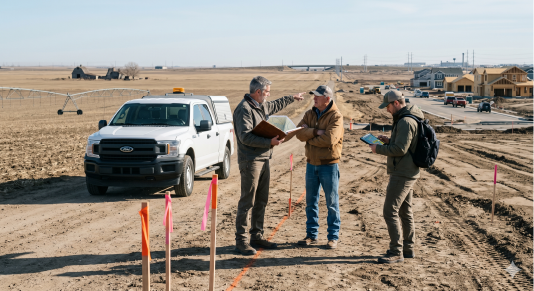
Aurora is growing east into ground that was farmed two decades ago, and the right-of-way work that comes with that growth is some of the most varied on the Front Range. A single project might pick up a fee parcel from a multi-generation Adams County farm, a permanent easement across an Arapahoe County subdivision still under construction, and a temporary construction easement next to Buckley Space Force Base — each with its own legal posture, its own appraisal frame, and its own pace.
Western States Land Services has acquired ROW for Aurora-area projects for decades. Our Loveland headquarters is a straightforward drive across the Front Range, and our agents are regulars at the Adams County clerk's office in Brighton, the Arapahoe County office in Centennial, and the Aurora Municipal Center on East Alameda. This page covers how Aurora projects actually get done.
Why right-of-way work in Aurora requires local expertise
Aurora is a hybrid jurisdiction in almost every way. The city sits across two counties — Adams to the north, Arapahoe to the south — with different recording practices, different stormwater rules, and different cultural expectations for landowner contact. The City of Aurora has its own ROW staff, its own engineering review, and its own permit framework. Aurora Water operates a sprawling infrastructure footprint that includes the Prairie Waters Project — a long pipeline-and-reservoir system pulling South Platte water back into Aurora's supply — and participation in the WISE partnership with Denver Water and South Metro Water.
The geographic spread complicates things further. Aurora's expansion corridor runs east of E-470 across what used to be wheat ground. Old surface deeds carry mineral severances from the early 20th century that the original sellers may have stopped tracking. Center-pivot operations are still active on the city's eastern edge. Aurora Reservoir sits in the middle of the city's water system, and the surrounding open space carries its own conservation overlays. None of this kills a project — but ignoring any of it does.
E-470 and I-225 set the connectivity backbone. Buckley Space Force Base creates a federal corridor that pulls in NEPA, Section 106, and Department of Defense coordination on any project in its footprint. The Anschutz Medical Campus drives utility, transportation, and access work across the Fitzsimons district. Smith Road industrial corridor and the Colfax/I-70 commercial spine each have their own recurring acquisition patterns. A firm that doesn't know which parcel sits in which framework loses time on every project.
Right-of-way services Aurora projects rely on
Aurora's project mix demands all four core services, and the way they fit together matters more than how they work individually.
Right-of-way acquisition
Aurora ROW acquisition runs the full range. On the eastern expansion edge, projects acquire fee for new arterial centerlines and detention pond sites, with permanent easements for utility tie-ins along ground that's transitioning from agricultural to suburban. In established neighborhoods, acquisitions tend toward easements — Aurora Water mains, Xcel distribution upgrades, fiber installations — with temporary construction easements alongside.
Right-of-way acquisition on Aurora projects often involves landowners in active transition. The family selling 80 acres on Quincy Avenue may have farmed it for three generations and still be working it during negotiation. The developer who closed last year may already be the seller of record on the next phase. Knowing how to read who's actually across the table — owner, family member, tenant, contracting developer — is part of getting the deal right.
Title research and due diligence
Aurora title work has a few recurring complications. Mineral severances on Eastern Plains parcels Aurora has annexed are common; a clean-looking surface acquisition can sit on top of an active mineral lease that gives the operator priority access. Subdivision plat history in the older parts of Aurora can be tangled, with vacated alleys and dedicated rights-of-way that may or may not have been formally relinquished.
Title research and due diligence for Aurora projects runs across both Adams and Arapahoe county recorders, and sometimes Douglas where annexations reach south. Modern records are digitized in both counties, but older records — particularly on Adams County agricultural parcels — still require microfilm and paper review. Curative work on heirship and probate issues is routine on east-side parcels.
Permitting and project management
Aurora permitting layers City of Aurora reviews onto Adams or Arapahoe County requirements. Stormwater and grading permits move through the city for projects inside city limits and through the relevant county for projects outside the boundary. Aurora Water has its own technical standards for water and wastewater work that interact with the WISE partnership and the Prairie Waters Project framework.
Permitting and project management on Aurora projects routinely picks up CDOT Region 1 access permits for I-225, E-470, and I-70 work; FAA Form 7460 review for tall structures within Buckley airspace; and Department of Defense coordination for any project that touches federal land near Buckley or affects classified airspace. Federal nexus shows up regularly through Buckley and through federally-funded transportation work.
Uniform Act relocation assistance
Aurora doesn't see displacement at the same density as central Denver, but it does come up — particularly on Aurora Water transmission corridors that cross older neighborhoods, on transportation projects through Smith Road industrial parcels, and on the rare residential relocations driven by federal corridor work. When displacement happens, Uniform Act relocation assistance requires advisory services that account for Aurora's local rental and sale market, the school district considerations that drive family decisions, and the practical realities of finding replacement housing on a tight schedule.
For business displacements — common on Smith Road and along the Colfax corridor — reestablishment costs, search expenses, and operational continuity all need careful documentation.
Recurring Aurora project types
A working list of the projects that show up most often in Aurora ROW programs:
Aurora Water transmission and treatment infrastructure. Pipeline expansions tied to Prairie Waters and WISE, treatment plant expansions, drainage improvements. These projects routinely involve permanent easements through residential and agricultural parcels with significant landowner engagement.
City of Aurora arterial and intersection projects. Roadway extensions on the east side, intersection improvements at high-volume crossings, multimodal corridor work on Colfax and other primary arterials. CDOT Region 1 coordinates the state highway pieces.
Subdivision and master-planned community infrastructure. Aurora's eastward expansion drives continuous private-development ROW work — utility tie-ins, drainage corridors, arterial dedications. These projects move on developer schedules and require agile field work.
Buckley Space Force Base coordination. Any project in or near Buckley pulls in federal review processes, Department of Defense coordination, and frequently NEPA and Section 106 requirements. Projects also have to account for airspace and security overlays.
Anschutz Medical Campus and Fitzsimons district work. Utility, parking, and access projects supporting the medical campus generate steady ROW work in a uniquely federal-state-private mix.
Telecommunications and broadband installations. Fiber buildouts under and across Aurora ROW, often involving multiple jurisdictions on a single corridor. Coordination with the city, the counties, and any affected utilities is the work.
How Western States supports Aurora projects
Our Loveland headquarters keeps us close to the Front Range work, and our 45+ years of regional experience means we already know the people who recur on Aurora projects — the Aurora Water staff, the Adams and Arapahoe county recorders' offices, the title professionals who handle high-volume Aurora work, the surveyors who cover the eastern expansion area, and the counsel who appears on routine curative actions.
We're CDOT-prequalified, federally compliant, and built to staff projects that span multiple jurisdictions without losing the local familiarity that good ROW work depends on. We integrate ROW acquisition, title research, permitting, and Uniform Act relocation under one team. For Aurora projects that cross into Western Slope corridors — water supply infrastructure tied to trans-mountain diversions, for instance — our Grand Junction office picks up the western-side work without a handoff to a different firm.
We don't run a one-size-fits-all program. Aurora's mix of agricultural transitions, suburban infill, federal coordination, and water infrastructure means the right approach varies parcel by parcel. We staff accordingly.
Frequently asked questions
What does "Aurora annexation" mean for ROW work on a parcel?
When Aurora annexes a parcel, the city assumes municipal jurisdiction — zoning, ROW permitting, stormwater compliance, building review — even though the county clerk and recorder still holds the deed records. For a ROW project on an annexed parcel, that means the title work continues to run through the original county (Adams or Arapahoe) while the operating permits run through the city. Knowing which agency handles which piece avoids a lot of wasted time.
How are mineral severances handled on Aurora's east side?
Most agricultural parcels on Aurora's eastern edge have severed minerals from earlier transactions. The surface owner can grant an easement, but if minerals are active or leased, the mineral owner's rights take priority. For permanent infrastructure, the project usually needs to identify the mineral owner, evaluate any active leases, and either negotiate a non-disturbance agreement or — in some cases — adjust the alignment. Title research surfaces the severance; due diligence works the practical consequences.
Does Aurora Water handle its own right-of-way acquisitions?
Aurora Water has internal ROW staff, but most major project work runs through outside firms that handle field acquisition, title research, and any displacement work. Aurora Water sets project scope, technical standards, and program-level decisions; the firm carries the parcel-by-parcel work. The integration usually requires close coordination on permits and on the Prairie Waters and WISE-related corridors.
What permits does a developer need for new ROW dedications in Aurora?
For a new ROW dedication tied to a development project, the work usually requires a City of Aurora plat approval, an engineering review tied to the dedication, and any applicable county and CDOT coordination if the alignment touches a county or state ROW. Projects east of E-470 also typically pick up Aurora Water and stormwater coordination as part of the same package.
How does Buckley Space Force Base affect ROW projects nearby?
Buckley creates a federal nexus on any project in its operational footprint. That can mean NEPA review, Section 106 cultural resources review, FAA Form 7460 evaluation for any tall structure, and direct DOD coordination on projects affecting access, security, or classified airspace. Buckley coordination adds time but is workable when the project plans for it from the start.
Can businesses on Smith Road or Colfax be displaced under the Uniform Act?
Yes — when a federally-funded project causes displacement, business operators on Smith Road, Colfax, or any Aurora corridor are entitled to Uniform Act benefits. That includes moving expenses, reestablishment costs, search expenses for a replacement site, and in some cases a fixed payment based on net earnings. The work is detailed; the documentation has to support every claim. A firm with current Uniform Act experience handles the process cleanly.
Move your Aurora project forward
Aurora ROW work isn't generic Front Range acquisition. It's a distinct mix of agricultural transitions, federal coordination, water infrastructure, and multi-jurisdictional permitting — and the firms that get it right know the local agencies, the recorders' practices, and the landowner expectations across both Adams and Arapahoe counties.
Western States Land Services brings 45+ years of Colorado experience and a CDOT-prequalified, federally compliant team to Aurora-area projects. We handle right-of-way acquisition, title research and due diligence, permitting and project management, and Uniform Act relocation assistance — every piece of the work, integrated under one team.
For broader background on the process, see our complete guide to right-of-way acquisition. When you're ready to talk through an Aurora project, start a conversation. We'll walk through what your specific corridor needs and how to staff for it cleanly.


Frequently Asked Questions
Have questions about our sustainability initiatives, eco-friendly practices, or how you can make a positive impact?
Western States Land Services is headquartered in Loveland, Colorado. We primarily serve Colorado, Wyoming, Nebraska, Kansas, New Mexico, Utah, and Texas, with experience working on projects across the broader Mountain West.
Western States Land Services was founded in 1981. The firm has been providing right-of-way acquisition, relocation, and permitting services in Colorado and the Mountain West for more than 45 years. Our team carries more than 150 years of combined industry experience.
Yes. Western States Land Services is prequalified with the Colorado Department of Transportation (CDOT) for right-of-way services. The firm is also experienced in FHWA requirements and fully compliant with the Uniform Relocation Assistance and Real Property Acquisitions Policies Act for federally regulated projects.
We serve public agencies, municipal governments, state departments of transportation, investor-owned utilities, oil and gas companies, pipeline operators, and private infrastructure developers. We have delivered right-of-way services across every sector — from CDOT highway corridors and utility transmission lines to rural pipeline routes and municipal capital improvement projects.
We offer the staffing capacity of a large firm with the direct access and personal accountability of a specialized boutique. Clients work with senior leadership — not a call center. Our agents meet landowners face-to-face. Our regulatory knowledge is deep rather than generalized. We have never needed to ramp up on Colorado or Mountain West rules. We have been working inside them for over 40 years.
Yes. Western States Land Services has experience supporting eminent domain proceedings, including preparing waiver valuations, providing expert witness testimony, and coordinating with legal counsel throughout the condemnation process. Our team has worked alongside attorneys on both agency-initiated and privately sponsored condemnation actions across Colorado.
