

Right-of-Way Acquisition on Colorado Farms and Ranches: What to Expect
Right-of-way projects increasingly cross working farms and ranches across Colorado. Here is what agricultural landowners should expect from survey to restoration.
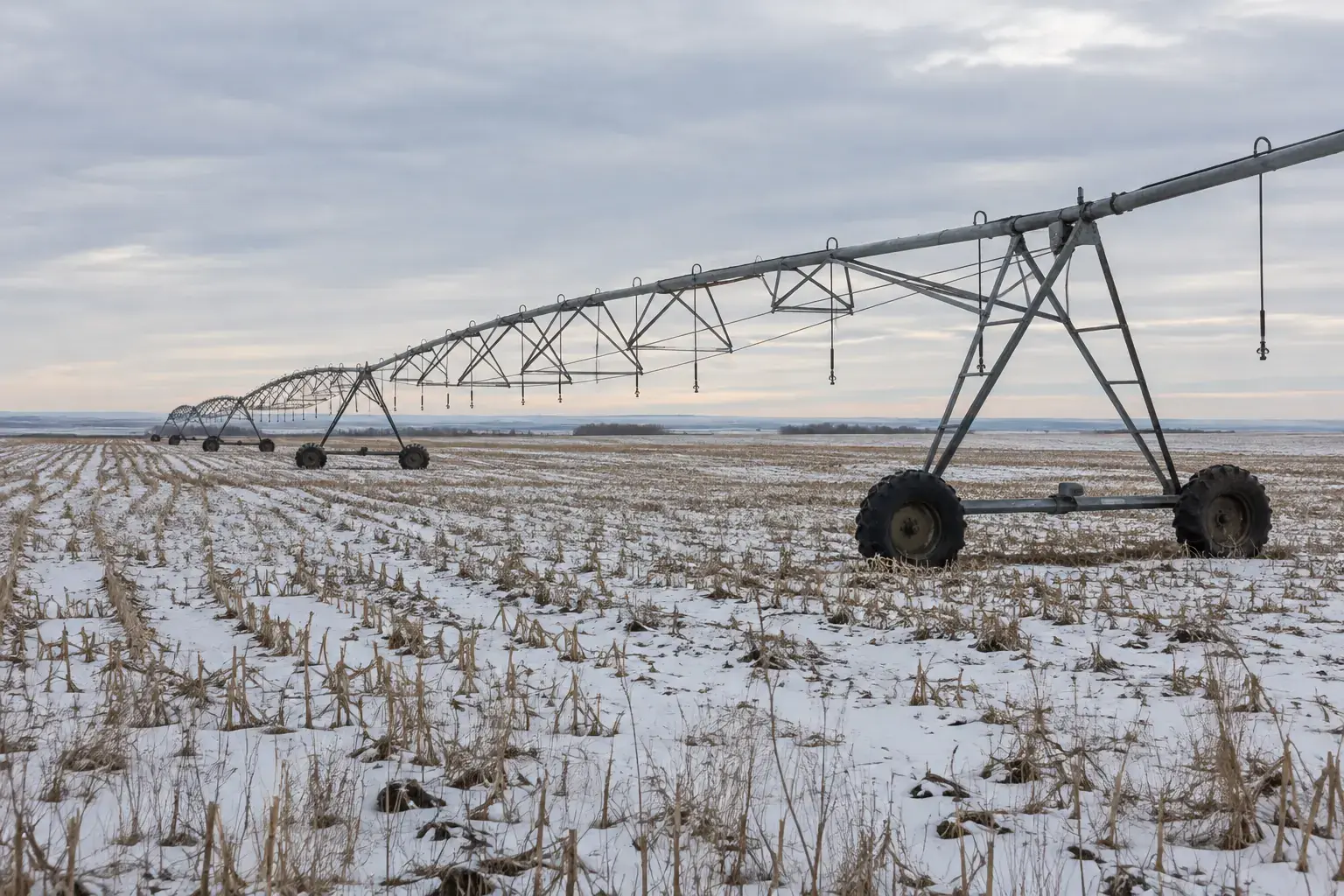
A right-of-way easement looks like a single line on a plat map. On a working farm or ranch, it runs through the planting schedule, the irrigation rotation, and the fence lines that keep livestock where they belong. Right-of-way acquisition on agricultural land in Colorado follows the same basic legal framework as any other acquisition, but the practical questions are different. How much ground actually comes out of production? Who pays when a center pivot has to be moved? What happens to an irrigation ditch that crosses the new alignment? This guide walks through what agricultural landowners, utilities, and project teams should expect when a transmission line, pipeline, or broadband route crosses working land.
Quick Summary
- Right-of-way acquisition on farms and ranches follows the same legal process as other property, but compensation and construction practices have to account for crops, livestock, and irrigation infrastructure.
- Compensation for an agricultural easement typically covers the value of the land rights taken, plus damage to improvements such as fencing and irrigation equipment, and lost use during construction.
- Permanent easements and temporary construction easements are compensated differently, and a separate payment for short-term use during construction is common in addition to the permanent easement value.
- Moving or relocating irrigation equipment, such as center pivots, gated pipe, or ditch headgates, is usually negotiated as part of the acquisition rather than left for the landowner to sort out alone.
- Ditch and irrigation company rights are often separate from the underlying landowner's rights, so a pipeline or transmission line crossing a ditch may need its own crossing agreement with the ditch company.
- Livestock operations need specific provisions for temporary fencing, gate access, and protection of water sources during construction.
- Restoration obligations, including decompacting soil, regrading, and reseeding with appropriate forage or crop varieties, should be spelled out in the easement agreement before construction starts.
- Agricultural landowners facing a first-time easement request are well served by having an attorney or an experienced right-of-way professional review the offer before they sign.
How Right-of-Way Projects Reach Colorado Farms and Ranches
Colorado's working land carries a lot of infrastructure across it. The Eastern Plains and the San Luis Valley host transmission corridors, oil and gas pipelines, and increasingly, fiber and broadband routes built to reach rural communities. Water infrastructure, including pipelines tied to municipal and regional water providers, often crosses irrigated farmland on its way from a reservoir or treatment facility to the communities it serves. None of this is new. What has changed is the pace. Grid upgrades, rural broadband expansion, and continued oil and gas development mean more agricultural landowners are receiving easement requests than in past decades.
For a landowner, that often means the first contact comes from a land agent representing a utility, a pipeline company, or a public agency, not from the end user of the infrastructure. At Western States Land Services, we work on behalf of these project sponsors, and our job is to explain the process clearly, answer questions honestly, and negotiate in good faith. A farm or ranch is a business, and an easement request deserves the same level of scrutiny a landowner would give any other contract affecting that business.
What Happens When a Project Crosses Working Land
Initial Contact and Survey
The process usually starts with a letter or a phone call explaining the project and requesting permission to survey. Surveyors and environmental teams need access to the proposed route well before any acquisition offer is made, typically to confirm the alignment, check for cultural or environmental resources, and identify existing infrastructure like buried irrigation lines. Landowners can usually set reasonable conditions on survey access, such as scheduling around planting or harvest, and should ask who to call if survey crews need to be on site unexpectedly.
Appraisal and Offer
Once the alignment is set, an appraiser values the property interest being acquired. For agricultural land, that valuation typically looks at the per-acre value of the easement area, any severance damage to the remainder of the parcel, and damages tied to specific improvements. The initial offer is built from that appraisal, and in most cases there is room to discuss it, particularly where the landowner can point to factors the appraiser may not have had full information about, such as planned improvements, drainage patterns, or how a specific field is actually farmed.
Negotiation
Good negotiation on agricultural easements is specific, not general. Vague promises to "restore the land" or "work with you during construction" are not worth much once equipment is in the field. The stronger approach ties every concern, access points, fencing, irrigation timing, restoration standards, to specific language in the easement document.
How Compensation Works for Agricultural Easements
Permanent Easements vs. Temporary Construction Easements
Most linear infrastructure projects use two kinds of easements on the same parcel: a permanent easement for the life of the facility, and a temporary construction easement that expires once the work is finished. They are valued differently, and a landowner should expect to see both broken out separately in an offer.
Easement TypeDurationWhat It Typically CoversPermanent easementLife of the facility, often in perpetuityThe land rights needed to operate and maintain the line, pipe, or facility long term, including access for repairsTemporary construction easementLimited period tied to the construction scheduleExtra working room needed during construction only, compensated similarly to a short-term leaseFee acquisitionPermanent, outright purchaseUsed less often on farmland, typically for facilities like substations or pump stations rather than linear easements
Crop Damage and Loss of Use
Crop damage is usually calculated separately from the easement value itself. A common approach prices out the expected yield on the affected acreage, using local yield data and current commodity prices, for the years the ground is out of production. If construction happens outside the growing season, loss of use may be minimal. If it happens mid-season, the damage calculation should reflect the actual crop in the ground, not a generic assumption about what that field usually grows.
Severance Damage to the Remainder
When an easement splits a field or creates an awkward farming pattern around a structure, the remainder of the parcel can lose value even though it was not directly taken. This is the same severance damage concept that applies to any partial taking, but on farmland it often shows up as lost efficiency, extra turns for equipment, or irrigation patterns that no longer line up cleanly with the field boundary. Documenting these impacts with specifics, not just general inconvenience, strengthens a landowner's position.
Livestock, Fencing, and Access During Construction
Livestock operations have needs that a standard easement template often misses. Temporary fencing has to actually contain the animals on that property, not just meet a generic specification. Gates need to stay where the operation needs them, not where it is most convenient for the contractor. Water sources, whether a stock tank, a well, or a ditch-fed trough, need protection from construction traffic and from any temporary dewatering or trenching nearby. Good agreements name these requirements specifically and assign a point of contact for problems that come up during construction, because livestock problems do not wait for the next scheduled check-in.
Irrigation Infrastructure and Ditch Crossings
Center Pivots, Gated Pipe, and Buried Lines
Center pivot systems, gated pipe, buried mainlines, and wheel lines all represent real capital investment, and moving or working around them is rarely simple. A pivot that has to be shortened or re-routed around a structure changes the irrigated acreage for the life of the pivot, not just during construction. These impacts should be priced as part of the acquisition, and the agreement should specify who is responsible for reconnecting and testing irrigation equipment once construction is complete.
Ditch and Canal Company Agreements
Colorado's irrigation water often moves through ditches and canals owned and operated by mutual ditch companies, which hold their own property rights in the ditch easement separate from the underlying landowner. A pipeline or transmission line that crosses a ditch typically needs its own crossing agreement with the ditch company, in addition to whatever agreement is reached with the landowner. These agreements usually address minimum pipe cover, construction timing around the irrigation season, and who is responsible for the crossing structure going forward. Skipping this step is one of the more common causes of delay on projects that cross irrigated farmland, so identifying every ditch and canal company along a route early is worth the effort.
Restoration: Getting the Land Back to Work
Construction ends. Farming does not. Restoration standards should be in writing before construction starts, not negotiated after the fact when the crew has already moved to the next job. At a minimum, a good restoration standard addresses decompaction of soil in the work area, regrading to match original drainage patterns, replacement of topsoil in its original sequence rather than mixed with subsoil, and reseeding with the landowner's preferred forage or crop variety where applicable. Noxious weed control also deserves attention, since equipment moving between properties can introduce species the landowner has spent years trying to keep out. Where a project displaces a residence or other structure as part of a federally funded undertaking, relocation assistance may be available under the Uniform Relocation Act and its implementing regulations at 49 CFR Part 24, though this applies less often on straightforward easement crossings than on full acquisitions.
What Is a Right-of-Way Easement on a Farm or Ranch?
A right-of-way easement on agricultural land is a legal right granted to a utility, pipeline company, or government agency to use a defined strip of a farm or ranch for a specific purpose, such as a power line, pipeline, or buried fiber route, while the landowner keeps ownership of the underlying property and, in most cases, continues farming or grazing around it.
Steps in Agricultural Right-of-Way Acquisition
- The project sponsor identifies a proposed route or facility location that crosses the property.
- A land agent contacts the landowner to request survey access and explain the project.
- Surveyors and environmental specialists document the route, existing infrastructure, and site conditions.
- An appraiser values the easement, any severance damage, and damages to specific improvements.
- The project sponsor presents a written offer, and negotiation follows, often with input from an attorney or right-of-way consultant.
- Once terms are agreed, the easement is recorded, construction proceeds under the agreed conditions, and restoration follows according to the standards in the agreement.
What to Ask Before You Sign
- Does the offer separate the permanent easement value from any temporary construction easement payment?
- How is crop damage calculated, and does it reflect what is actually planted on the affected ground?
- Who is responsible for moving, reconnecting, and testing irrigation equipment affected by construction?
- Are fencing, gate locations, and livestock water protection specified, not just generally promised?
- Does the agreement name a specific restoration standard, including soil decompaction and reseeding?
- Has every ditch or canal company along the route been identified and addressed separately from the landowner agreement?
- Is there a named point of contact for problems that come up during construction?
Conclusion and Next Steps
Right-of-way acquisition on agricultural land is not fundamentally different from acquisition on any other property, but the details that matter most, crop damage, irrigation infrastructure, livestock access, and restoration, are specific to how the land is actually farmed or ranched. An offer that looks reasonable on paper can still miss the operational realities of a particular field or herd. Landowners facing a first easement request should read the agreement carefully, ask specific questions, and involve an attorney when the project is complex or when more than one type of land right, surface, water, or mineral, is affected. Nothing here is legal advice for a specific situation, and every parcel and every project is different enough that general guidance only goes so far.
If your operation has been contacted about a right-of-way project, or if you are a utility, agency, or project manager planning work that crosses agricultural land in Colorado, we are glad to start a conversation. No obligation and no agenda, just a straight answer about what the process looks like for your specific situation.
Frequently Asked Questions
Do I have to allow a utility or pipeline company onto my farm for a survey?
In most cases, a company needs the landowner's permission before entering private land to survey, though some utilities and public agencies hold statutory survey access rights under specific conditions. Landowners can typically negotiate reasonable scheduling and notice requirements even when access is granted. A specific situation involving disputed access is worth discussing with an attorney.
How is crop damage compensated in a right-of-way easement?
Crop damage is usually calculated using the expected yield on the affected acreage, local yield data, and current commodity prices for the period the ground is out of production, separate from the value of the easement itself. The exact approach varies by project and by what is actually planted at the time of construction.
Can I still farm or graze land that has a transmission line or pipeline easement?
In most cases, yes. Permanent easements are typically written to allow continued farming or grazing around the facility, with restrictions limited to structures, deep tillage, or digging near the specific infrastructure. The easement document should spell out exactly what uses remain permitted.
What happens to my irrigation ditch if a pipeline crosses it?
The pipeline company typically needs a separate crossing agreement with the ditch or canal company that owns the ditch rights, in addition to any agreement with the underlying landowner. That agreement usually sets requirements like minimum pipe depth and construction timing around the irrigation season.
Should I hire an attorney before signing an easement agreement on agricultural land?
For a straightforward, well-explained offer on a small portion of land, some landowners choose to negotiate directly. For anything involving a significant acreage, multiple types of land rights, or terms that are unclear, an attorney experienced in right-of-way or real property matters can help make sure the agreement actually protects the operation long term.
Frequently Asked Questions
Have questions about our sustainability initiatives, eco-friendly practices, or how you can make a positive impact?
Western States Land Services is headquartered in Loveland, Colorado. We primarily serve Colorado, Wyoming, Nebraska, Kansas, New Mexico, Utah, and Texas, with experience working on projects across the broader Mountain West.
Western States Land Services was founded in 1981. The firm has been providing right-of-way acquisition, relocation, and permitting services in Colorado and the Mountain West for more than 45 years. Our team carries more than 150 years of combined industry experience.
Yes. Western States Land Services is prequalified with the Colorado Department of Transportation (CDOT) for right-of-way services. The firm is also experienced in FHWA requirements and fully compliant with the Uniform Relocation Assistance and Real Property Acquisitions Policies Act for federally regulated projects.
We serve public agencies, municipal governments, state departments of transportation, investor-owned utilities, oil and gas companies, pipeline operators, and private infrastructure developers. We have delivered right-of-way services across every sector — from CDOT highway corridors and utility transmission lines to rural pipeline routes and municipal capital improvement projects.
We offer the staffing capacity of a large firm with the direct access and personal accountability of a specialized boutique. Clients work with senior leadership — not a call center. Our agents meet landowners face-to-face. Our regulatory knowledge is deep rather than generalized. We have never needed to ramp up on Colorado or Mountain West rules. We have been working inside them for over 40 years.
Yes. Western States Land Services has experience supporting eminent domain proceedings, including preparing waiver valuations, providing expert witness testimony, and coordinating with legal counsel throughout the condemnation process. Our team has worked alongside attorneys on both agency-initiated and privately sponsored condemnation actions across Colorado.
