

Right-of-Way and Land Acquisition for EV Charging Stations in Colorado
As Colorado races toward a statewide EV charging network, the work that determines whether a site gets built often happens before a single charger arrives: securing the land, easements, and permits.
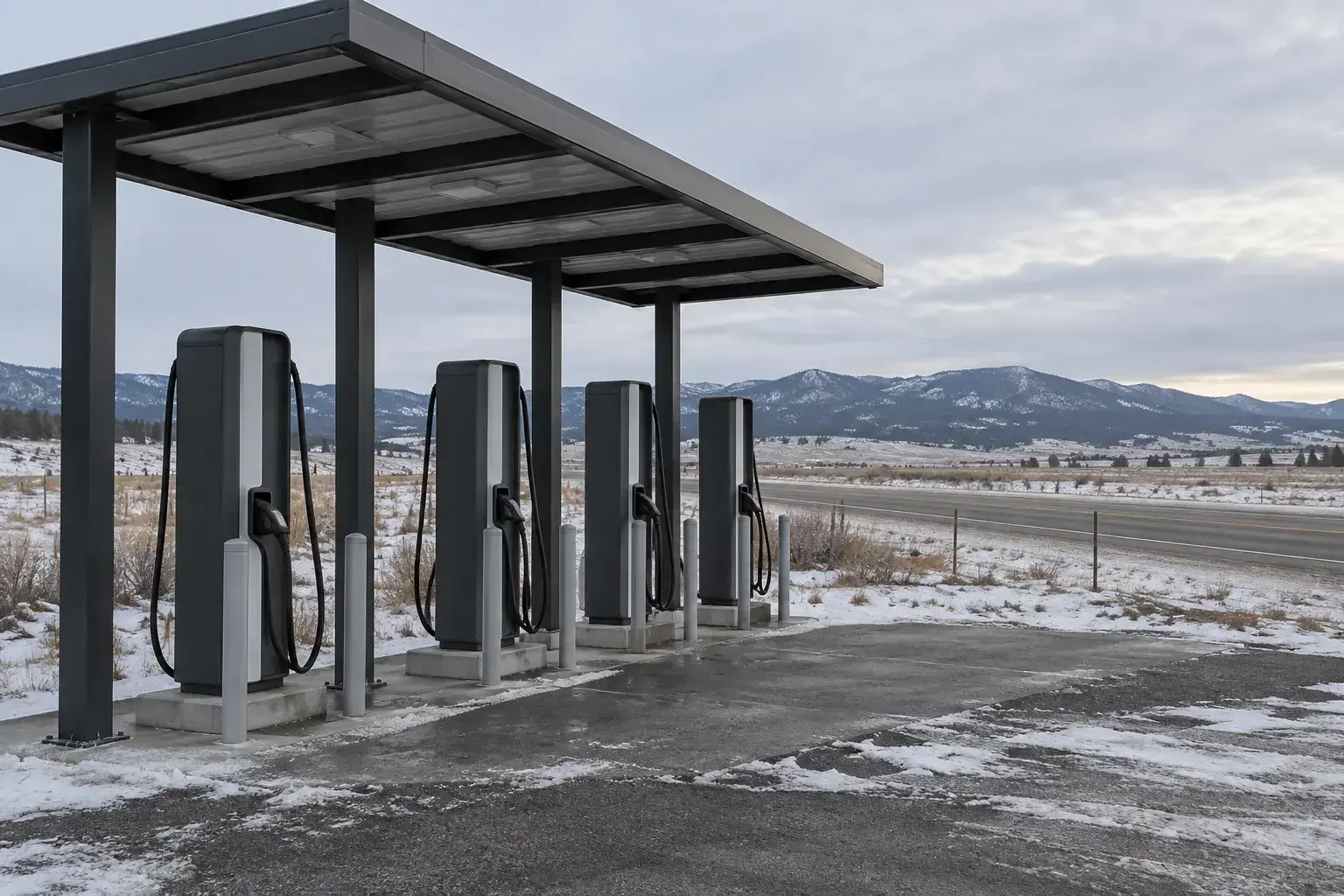
Building a fast-charging plaza is not a construction problem first. It is a land problem first. Steel, conduit, and transformers are the easy part. The harder part is right-of-way and land acquisition for EV charging stations in Colorado: figuring out who owns the parcel, who controls the access point, and who has the right to bring new power to it. Colorado's charging network is expanding quickly this year, even as federal funding behind it has gone through real turbulence. That combination makes the land and easement work behind each site worth understanding, whether you are a public agency, a utility, a site developer, or a landowner who has been approached about a potential charging location. This post walks through what that work actually involves, from parcel requirements through permitting.
Quick Summary
- An EV charging station needs more than a parking lot. Most sites require a title search, an access easement or permit, and often a new utility easement to bring enough power to the location.
- Colorado had roughly 486 public fast-charging locations statewide as of August 2026, with 83 percent of the state highway network within 30 miles of a DC fast charger, up from about 40 percent in 2020.
- Federal NEVI funding for Colorado was paused in 2026, then partially restored after a multi-state lawsuit, so the state has funded recent charging grant rounds entirely with state dollars.
- Land for a charging site can be acquired through fee simple purchase, a long-term ground lease, or an easement, and the right structure depends on who will own and operate the equipment.
- Due diligence for a charging site typically covers title research, a review of existing easements and encumbrances, confirmation of legal access, and a check on available utility capacity.
- Permitting usually involves local land use approval, a CDOT access permit where the site fronts a state highway, and a separate interconnection agreement with the serving utility.
- Uncertain federal funding timelines make early, careful land work more important, not less. Delays on the land side tend to compound delays on the funding side, not cancel them out.
Colorado's EV Charging Buildout Is Accelerating, and the Funding Picture Is Complicated
Colorado has been building toward a statewide fast-charging network for several years, and 2026 has been a milestone year for that effort. As of late August 2026, the state had about 486 public DC fast-charging locations, with 17 NEVI-funded sites open and roughly 33 more awarded and under development. CDOT reported that 83 percent of the state highway network now sits within 30 miles of a fast charger, more than double the 40 percent figure from 2020. The state is approaching what the Federal Highway Administration calls "fully built out" status under its updated criteria for Alternative Fuel Corridors.
The funding behind that progress has not been smooth. Colorado's share of National Electric Vehicle Infrastructure, or NEVI, funding under the 2021 Infrastructure Investment and Jobs Act was expected to total about $56.5 million over five years, administered under rules at 23 CFR Part 680. In 2026, the federal government paused NEVI reimbursements nationwide. A coalition of states, Colorado among them, sued over the pause, and a federal judge granted a preliminary injunction in June that unfroze funding for most of the plaintiff states. Colorado kept moving in the meantime. The state funded its most recent Direct Current Fast-Charging Plazas grant round, a $5 million award adding 56 new charger ports at nine sites, entirely with state money rather than waiting on federal dollars. Governor Jared Polis has said the state intends to keep funding charging infrastructure regardless of how the federal picture settles.
None of this changes the fact that every one of those stations sits on land someone had to acquire, lease, or secure an easement across. That is where right-of-way work comes in, and it is often the least visible part of the project until something goes wrong with it.
Why an EV Charging Plaza Is a Land Acquisition Project Before It Is a Construction Project
The Parcel Problem: Visibility, Access, and Turning Radius
A good charging site is not just an empty lot near a highway. It needs direct, legal access to the road network, enough frontage for cars and sometimes semi-trucks to enter and exit safely, and a turning radius that works for the vehicles the station is built to serve. Many of the best candidate parcels sit at interchanges or along frontage roads where access rights are already carved up among several owners, which means confirming legal access can take as long as confirming ownership.
Visibility from the highway matters for site economics, but it often means the parcel a developer wants is not the parcel that is actually for sale or easily leased. That gap is usually closed through negotiation, not through finding a better-located alternative, which is one reason land acquisition timelines for charging sites tend to run longer than the construction schedule that follows them.
Grid Capacity and the Utility Easement Question
Fast chargers draw far more power than a typical commercial building, and the nearest distribution line does not always have the capacity to support a multi-port DC fast-charging plaza. In many projects, the utility needs a new or expanded easement to bring adequate service to the site, sometimes requiring new poles, conduit, or even a small substation upgrade some distance away. That easement work runs on a separate track from the real estate deal for the charging parcel itself, and it needs to start early. A site with a signed ground lease and no confirmed path to power is not a site that is ready to build.
Due Diligence Before You Site a Charging Station
Due diligence for a charging site looks similar to due diligence for any commercial land acquisition, with a few items that matter more than usual given how power-dependent these projects are.
- Title research. Confirms who actually owns the parcel, whether there are liens or competing claims, and whether prior easements already limit what can be built.
- Existing easements and encumbrances. A parcel that looks open on a site plan may already carry a drainage easement, a pipeline easement, or deed restrictions that conflict with charger placement or canopy structures.
- Legal access confirmation. Especially at interchanges and along state highway frontage, access points are often controlled by access permits rather than simple ownership, and those permits do not always transfer automatically with a sale.
- Utility capacity and easement path. A preliminary check with the serving utility on available capacity and the likely route for a new easement, done before the deal closes rather than after.
- Environmental and floodplain review. Standard for most commercial sites, and particularly relevant for parcels near highway drainage corridors or former fueling and service station uses.
Lease, Easement, or Fee Simple: Choosing the Right Acquisition Structure
There is no single right answer here. The right structure depends on who will own the charging equipment, how long the project is expected to operate, and how much control the landowner wants to keep.
StructureTypical UseKey ConsiderationsFee simple purchaseStandalone charging plazas built and owned by a public agency, utility, or dedicated charging operatorFull control over the site long term, but higher upfront cost and a longer closing process involving full title workGround leaseCharging stations added to an existing retail, travel plaza, or truck stop parcelLower upfront cost and faster to execute, but lease term length and renewal terms need to match the equipment's expected service lifeEasementAccess improvements, utility interconnection, or shared-use charging areas on land the operator does not otherwise need to controlNarrower rights than a lease or purchase, so the easement language has to spell out exactly what equipment, access, and maintenance rights are included
Permitting a Charging Site in Colorado: What to Expect
Permitting for a charging station typically runs on three parallel tracks. Local land use approval covers zoning compatibility, site plan review, and sometimes a conditional use permit depending on the jurisdiction. A CDOT access permit is required wherever a site takes access from a state highway, and that process looks closely at turning movements, sight distance, and any proposed changes to an existing curb cut. Utility interconnection runs separately, through an interconnection agreement with the serving utility that covers capacity, easement needs, and the construction schedule for bringing power to the site. For publicly funded projects, there is often a fourth track layered on top: compliance with the funding program's own siting and reporting requirements, which for NEVI-funded sites means following the standards at 23 CFR Part 680.
Done well, this permitting work runs quietly in parallel with the land acquisition and never becomes the thing that delays the project. Done poorly, each track waits on the others, and a station that could have opened in a year takes two.
Does an EV Charging Station Need an Easement?
In most cases, yes, at least for utility interconnection. Even a charging station built on land the operator owns outright typically needs a separate utility easement to bring power from the nearest adequate source to the site, and projects that share access with an adjoining parcel or sit on leased land often need an access easement as well.
Steps to Secure Land Rights for an EV Charging Site
- Identify candidate parcels based on highway visibility, access, and proximity to adequate utility infrastructure.
- Run preliminary due diligence, including a title search and a utility capacity inquiry, before committing to a specific site.
- Decide on the acquisition structure, fee simple, ground lease, or easement, based on who will own and operate the equipment.
- Negotiate and document access rights separately from ownership or lease terms if the parcel shares a curb cut or driveway with another property.
- Secure the utility easement and interconnection agreement in parallel with the real estate transaction, not after it closes.
- File for local land use approval and, where applicable, a CDOT access permit.
- Close the transaction and record all easements, access agreements, and utility documents before construction begins.
Right-of-Way Checklist for EV Charging Site Development
- Title report confirming ownership and existing encumbrances
- Confirmed legal access, including any required access permit
- Utility capacity verification and a secured easement path for interconnection
- Local zoning and site plan approval
- CDOT access permit, if the site fronts a state highway
- Recorded easements and lease or purchase documents in place before construction
What Funding Uncertainty Means for Land and Timeline Planning
The NEVI funding pause and the litigation that followed are a reminder that public funding timelines can shift even after a project has been awarded money. That uncertainty does not usually change the land acquisition work itself, but it changes how agencies and developers should sequence it. Projects that treat title research, easement negotiation, and permitting as work that happens only after funding is fully secured tend to lose the most time when funding slips. Projects that run land work and funding applications on parallel tracks are in a much better position to move quickly whenever the money is confirmed.
This is not a substitute for legal or financial advice specific to any one project, and funding rules change. Anyone relying on a specific grant program's current requirements should confirm them directly with the administering agency before making commitments.
Conclusion
Colorado's charging network is growing fast, and the land and easement work behind each site is becoming a specialty of its own. The projects that move smoothly are almost always the ones where title research, access confirmation, utility easements, and permitting started early and ran in parallel, not the ones that waited until funding was locked in to think about the land. Our team at Western States Land Services works through exactly these issues, right-of-way acquisition, title research and due diligence, easement negotiation, and permitting coordination, for infrastructure, utility, and transportation projects across Colorado. If you are evaluating a charging site, a utility interconnection easement, or any other land acquisition tied to an infrastructure project, we are glad to start a conversation. No obligation and no agenda, just a conversation about what your project actually needs.
Frequently Asked Questions
Does an EV charging station need a separate utility easement?
In most cases, yes. Fast chargers draw significant power, and bringing adequate service to a site often requires a new or expanded utility easement even when the charging operator owns the parcel outright.
Can an EV charging station be built on leased land in Colorado?
Yes. Ground leases are common, particularly when a charging plaza is added to an existing retail center, travel plaza, or truck stop. The lease term should be matched to the expected service life of the charging equipment and any funding program requirements tied to the site.
Does a charging site need a CDOT permit?
A CDOT access permit is typically required when a site takes access directly from a state highway. Sites accessed only from local roads generally go through the local jurisdiction's permitting process instead.
How long does land acquisition for an EV charging site usually take?
Timelines vary widely depending on the number of parties involved in title and access, whether a new utility easement is needed, and how quickly local and state permits move. Running title work, utility coordination, and permitting in parallel, rather than one after another, is typically the biggest factor in keeping the timeline shorter.
Is federal funding still available for EV charging infrastructure in Colorado?
Federal NEVI funding for Colorado was paused in 2026 and later partially restored following a multi-state lawsuit, but that status has shifted more than once this year and could change again. Colorado has continued funding charging infrastructure grant rounds with state money in the meantime. Anyone relying on a specific funding program should confirm its current status directly with the administering agency before making commitments.
Frequently Asked Questions
Have questions about our sustainability initiatives, eco-friendly practices, or how you can make a positive impact?
Western States Land Services is headquartered in Loveland, Colorado. We primarily serve Colorado, Wyoming, Nebraska, Kansas, New Mexico, Utah, and Texas, with experience working on projects across the broader Mountain West.
Western States Land Services was founded in 1981. The firm has been providing right-of-way acquisition, relocation, and permitting services in Colorado and the Mountain West for more than 45 years. Our team carries more than 150 years of combined industry experience.
Yes. Western States Land Services is prequalified with the Colorado Department of Transportation (CDOT) for right-of-way services. The firm is also experienced in FHWA requirements and fully compliant with the Uniform Relocation Assistance and Real Property Acquisitions Policies Act for federally regulated projects.
We serve public agencies, municipal governments, state departments of transportation, investor-owned utilities, oil and gas companies, pipeline operators, and private infrastructure developers. We have delivered right-of-way services across every sector — from CDOT highway corridors and utility transmission lines to rural pipeline routes and municipal capital improvement projects.
We offer the staffing capacity of a large firm with the direct access and personal accountability of a specialized boutique. Clients work with senior leadership — not a call center. Our agents meet landowners face-to-face. Our regulatory knowledge is deep rather than generalized. We have never needed to ramp up on Colorado or Mountain West rules. We have been working inside them for over 40 years.
Yes. Western States Land Services has experience supporting eminent domain proceedings, including preparing waiver valuations, providing expert witness testimony, and coordinating with legal counsel throughout the condemnation process. Our team has worked alongside attorneys on both agency-initiated and privately sponsored condemnation actions across Colorado.
