

Eminent Domain in Right-of-Way Acquisition: A Plain-Language Guide for Landowners and Project Teams
A plain-language guide to eminent domain in right-of-way acquisition — the constitutional basis, the step-by-step process, Colorado procedure under C.R.S. § 38-1-101, landowner rights, and why most projects never go there.
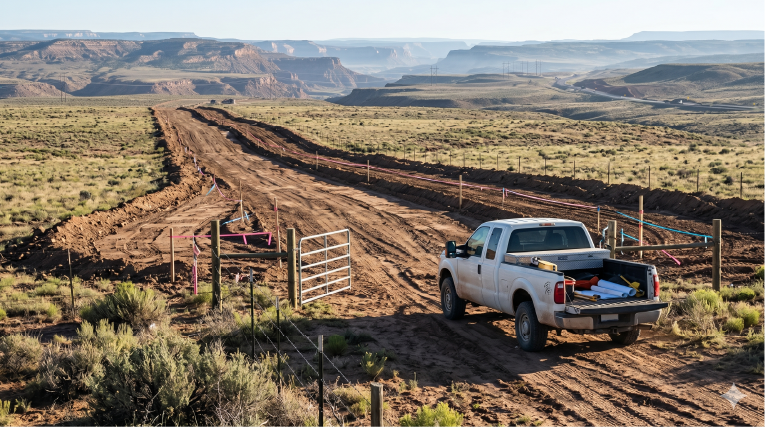
Eminent domain is the legal authority of a government — or a private entity granted that authority by statute — to compel the transfer of private property for public use in exchange for just compensation. In right-of-way work, it's the backstop that keeps a single holdout from blocking a public project, but it's almost never the opening move. On a well-run program, more than 95% of right-of-way parcels close through voluntary negotiation, and condemnation is reserved for the small number of cases where genuine effort hasn't produced agreement.
This guide walks through what eminent domain is, where the authority comes from, how the process actually moves through court, what protections landowners have at every step, and why experienced project teams treat it as a last resort rather than a strategy.
What is eminent domain?
Eminent domain is the inherent power of the sovereign to take private property for public use. In the United States, it's exercised by federal, state, and local governments, and by certain private entities — public utilities, pipeline companies, railroads, and similar quasi-public actors — that have been granted condemnation authority by statute.
The exercise of eminent domain is called condemnation. The two terms get used interchangeably in everyday conversation, but technically eminent domain is the authority and condemnation is the legal proceeding that exercises it.
When eminent domain is used, the property doesn't disappear. It transfers — by court order if necessary — to the condemning authority. The original landowner is entitled to "just compensation," paid in cash, before possession changes hands.
The constitutional basis: the Fifth Amendment Takings Clause
Eminent domain in the United States is constrained by the Fifth Amendment to the U.S. Constitution, which ends with the Takings Clause: "nor shall private property be taken for public use, without just compensation."
That single sentence does two important things. It assumes the government has the power to take property — eminent domain is treated as a pre-existing authority, not one the Constitution creates. And it imposes two limits: the taking must be for public use, and it must be accompanied by just compensation.
The Fourteenth Amendment extends those same protections to actions by state and local governments. Every state constitution also contains its own takings clause, often with additional protections beyond the federal floor. Colorado's Article II, Section 15 mirrors the federal language and is the foundation of Colorado eminent domain practice.
The public-use requirement
A taking has to serve a public purpose. Highways, public utilities, water and wastewater systems, schools, parks, and similar projects have always qualified.
The harder question is what counts as "public use" beyond the obvious cases. The U.S. Supreme Court's 2005 decision in Kelo v. City of New London held that economic development could qualify as public use under the federal Constitution, but the political reaction was swift. Most states — Colorado included — tightened their own laws to limit purely economic-development takings.
In Colorado, the public-use determination is made by the court if the landowner challenges it. A project sponsor must show statutory authority to condemn and demonstrate that the proposed use serves a recognized public purpose. For right-of-way acquisition tied to highways, utilities, pipelines with FERC certificates, and similar infrastructure, the public-use threshold is generally well-established.
The just-compensation requirement
The other constitutional limit is just compensation, almost always defined as fair market value — what a willing buyer would pay a willing seller in an arm's-length transaction, neither under any compulsion to act.
Just compensation isn't only the value of the strip of land being taken. It also includes:
How these pieces fit together is a discipline of its own. We dig into the methodology in our companion guide on just compensation and property valuation in right-of-way acquisition.
When eminent domain gets used vs. when it doesn't
The fundamental question on every project is whether to negotiate or condemn. The answer in almost every case is: negotiate first, condemn only when negotiation has demonstrably failed.
Reasons negotiation works for the vast majority of parcels:
Eminent domain genuinely is necessary when:
A project that defaults to condemnation on the first sign of resistance signals to every other landowner on the corridor that talking is pointless. That posture costs more in the long run than the time spent negotiating in good faith.
The condemnation process step by step
The exact procedure varies by state, but most jurisdictions follow a similar arc.
1. Pre-condemnation negotiation and offer
Before filing, the condemning authority must make a good-faith attempt to negotiate. For federally funded projects, the Uniform Act (49 CFR Part 24) requires a written offer at or above the appraised value, an explanation of how compensation was calculated, and a reasonable opportunity for the owner to consider it.
2. Notice of intent to condemn
If negotiation fails, the project sponsor sends formal notice that condemnation will be filed if the parties can't reach agreement. This notice typically triggers a final settlement window.
3. Filing the petition
The condemnor files a condemnation petition (also called a complaint in condemnation or petition in condemnation) in the appropriate court. The filing identifies the property, the interest being acquired, the public use, and the offer that was rejected.
4. Service and answer
The landowner is served and has a defined period to file an answer, raise objections to the taking itself, or contest valuation.
5. Determination of necessity and authority
If the landowner challenges the taking on legal grounds — improper purpose, lack of statutory authority, procedural defects — the court rules first on whether the condemnation can proceed at all.
6. Valuation proceeding
Once the right to take is established, the case moves to the valuation phase. Depending on the jurisdiction, this is heard by the court, a panel of court-appointed commissioners, or a jury.
7. Payment and possession
Once valuation is determined and the judgment is entered, the condemnor deposits the awarded amount, takes legal title to the property interest, and the project can proceed. Most jurisdictions allow earlier possession by depositing the appraised amount with the court (often called "quick take") so construction isn't held up while valuation is litigated.
8. Appeals
Either side can appeal valuation. Appeals on the right-to-take portion are rarer but possible.
Colorado-specific procedure
Colorado eminent domain is governed primarily by C.R.S. § 38-1-101 and following sections, with additional procedural rules in the Colorado Rules of Civil Procedure.
Key features of Colorado practice:
Jurisdiction. Condemnation actions are filed in district court in the county where the property is located.
Mandatory mediation. Colorado requires the parties to attempt mediation before a valuation trial, which is one reason a high percentage of filed cases settle without ever reaching trial.
Commissioners or jury. The landowner can elect to have valuation determined by a panel of three court-appointed commissioners or by a jury. Each path has tactical implications a Colorado-experienced attorney can walk through.
Quick-take provisions. Colorado allows the condemnor to deposit the appraised value with the court and take immediate possession on most public projects, with valuation litigated separately.
Attorney fees and costs. In limited circumstances, a landowner who recovers materially more than the offered amount can recover certain costs and fees. The rules are narrow and specific.
CRS 38-1-121 valuation procedure. This statute spells out the appraisal-based valuation framework Colorado courts apply.
For a deeper Colorado treatment, see our Colorado right-of-way acquisition pillar, which covers C.R.S. § 38-1-101 alongside CDOT prequalification, the Uniform Act, and Colorado-specific complications like severed minerals and water rights.
Landowner rights throughout the process
Landowners retain meaningful protections at every stage:
A landowner facing condemnation isn't powerless. The process is structured to give them time, information, and avenues to contest. Our companion piece — a landowner's guide to right-of-way acquisition — walks through these rights from a landowner's point of view in more depth.
Why most projects avoid it
The hidden cost of condemnation isn't the legal fees. It's everything else.
Time. A contested condemnation case can run 12-24 months from filing through final judgment. Quick-take possession helps, but appraisal disputes still need resolution.
Cost. Attorney fees, expert witnesses, dual appraisals, court time. A contested condemnation case routinely costs the project sponsor $50,000-$250,000 in professional fees, sometimes more, on top of whatever the final compensation award turns out to be.
Reputational damage. Other landowners on the corridor watch how the project treats the first holdout. A condemnation filing — especially an aggressive one — hardens the rest of the negotiating environment.
Future projects. Counties and corridors are small worlds. A reputation for litigating with landowners follows a project sponsor into the next program in the same county.
Risk of a high verdict. Juries and commissioners can — and sometimes do — award significantly more than the appraised value. The condemnor pays the difference plus, in some cases, the landowner's costs.
For all of those reasons, project sponsors who use ROW agents well treat negotiation as the goal and condemnation as the rare exception.
Alternatives to condemnation
Before filing, experienced ROW teams exhaust softer tools:
Pairing those tools with strong upfront title research and due diligence — to make sure the right people are at the table — and integrated permitting and project management keeps most projects out of court entirely.
Frequently asked questions
What does eminent domain mean in plain language?
Eminent domain is the government's power to require a private property owner to sell — for fair market value — when the property is needed for a public project. It applies to highways, utilities, pipelines with statutory authority, and similar infrastructure. The owner can negotiate the price and terms, can challenge the taking in court, and is entitled to just compensation paid in cash, but cannot ultimately refuse the transfer if the legal requirements are met.
Who can use eminent domain?
Federal, state, and local governments have inherent eminent domain authority. Public utilities, pipeline companies (especially interstate gas pipelines under FERC jurisdiction), railroads, and certain other private entities have condemnation authority granted by statute. In Colorado, C.R.S. § 38-1-101 and related statutes spell out which entities can condemn and for what purposes. Private parties without statutory authority cannot condemn — they have to find a deal or reroute around the parcel.
Can a landowner refuse eminent domain?
A landowner can refuse a specific offer, can negotiate aggressively, and can challenge the taking in court on grounds of authority, public purpose, or procedure. What a landowner generally cannot do is permanently refuse a taking that meets the legal requirements. The constitutional protection is just compensation, not the right to keep the property indefinitely. In practice, the leverage is in negotiating value and terms, not in blocking the project entirely.
How is just compensation determined in eminent domain?
Just compensation is fair market value as of the date of taking, established by a certified appraisal that considers comparable sales, the property's highest and best use, and any damages to the remainder. On federally funded projects, the appraisal must follow Uniform Act standards in 49 CFR Part 24 and be reviewed by an independent review appraiser before any offer is made. If the owner disagrees, the matter ultimately goes to a court, commission, or jury for determination.
How long does an eminent domain case take in Colorado?
A Colorado condemnation case typically runs 6-18 months from filing to a final order, sometimes longer if appraisal issues are contested. Mandatory mediation often produces settlement before trial. Quick-take procedures under Colorado law allow the project to deposit the appraised value with the court and take possession quickly so construction isn't held up while valuation is litigated. Trial scheduling, expert availability, and county docket pressure all influence the actual timeline.
Does the Uniform Act apply when eminent domain is used?
Yes, when the project is federally funded or has a federal nexus. The Uniform Act (49 CFR Part 24) establishes minimum standards for property acquisition and relocation that apply whether the deal closes through negotiation or condemnation. That includes appraisal-based offers, written explanations of compensation, and Uniform Act-compliant relocation assistance for displaced residents and businesses. Failing to follow the Act risks federal funding clawbacks even after a successful condemnation.
What's the difference between eminent domain and condemnation?
Eminent domain is the legal authority — the underlying power to compel transfer for public use. Condemnation is the court proceeding that exercises that authority. In everyday usage the terms get blurred, and project teams often say a parcel "went into condemnation" when they mean a condemnation petition was filed. Both terms describe the same concept from different angles: one is the right to act, the other is the act itself.
What happens if I think the offer is too low?
You don't have to accept it. Negotiate first — most offers move when the landowner provides specific information about the property, comparable sales the appraiser missed, or impacts the appraisal didn't capture. You can also obtain your own appraisal, with reasonable costs reimbursed under the Uniform Act on federally funded projects. If that doesn't close the gap, a court, commission, or jury determines the final amount, and you may recover more than the original offer plus, in narrow Colorado circumstances, certain costs.
Can eminent domain be used for private projects?
Only when the private entity has been granted condemnation authority by statute and the project serves a recognized public use. Interstate gas pipelines under FERC, regulated public utilities, and railroads are the most common examples. Purely private projects — a developer building a private subdivision, a private commercial site — generally cannot condemn, even if there's an economic development case. State law often specifically prohibits private-to-private takings for economic development.
How often does eminent domain actually get used?
Far less often than its reputation suggests. On a well-run right-of-way program, more than 95% of parcels close through voluntary negotiation. The remaining few percent that proceed to condemnation usually settle before trial through mediation or pre-trial negotiation. Outright trial verdicts are rare. Project sponsors who treat condemnation as a routine tool rather than a last resort tend to spend more, take longer, and damage their position on every other parcel and every future project in the same area.
Move your project forward without going to court
Eminent domain is a real authority, and it has its place. But the projects that get built on time and on budget are the ones that prepare for negotiation as carefully as if condemnation weren't an option — because most of the time, it isn't, or it shouldn't be.
Western States Land Services has spent more than 45 years acquiring right-of-way for highways, utilities, pipelines, and municipal projects across Colorado and the Mountain West. We are CDOT-prequalified, federally compliant, and built around the kind of face-to-face landowner engagement that keeps the vast majority of parcels out of court — over 10,000 utility parcels and 800+ CDOT parcels, and counting.
If you're scoping a project, working through a contested parcel, or want a candid read on whether condemnation is genuinely necessary, start a conversation. We'll walk through your situation and tell you what we'd actually do. For more on the broader process, see our complete guide to right-of-way acquisition for the Western U.S. and our companion piece on a landowner's guide to right-of-way acquisition.


Frequently Asked Questions
Have questions about our sustainability initiatives, eco-friendly practices, or how you can make a positive impact?
Western States Land Services is headquartered in Loveland, Colorado. We primarily serve Colorado, Wyoming, Nebraska, Kansas, New Mexico, Utah, and Texas, with experience working on projects across the broader Mountain West.
Western States Land Services was founded in 1981. The firm has been providing right-of-way acquisition, relocation, and permitting services in Colorado and the Mountain West for more than 45 years. Our team carries more than 150 years of combined industry experience.
Yes. Western States Land Services is prequalified with the Colorado Department of Transportation (CDOT) for right-of-way services. The firm is also experienced in FHWA requirements and fully compliant with the Uniform Relocation Assistance and Real Property Acquisitions Policies Act for federally regulated projects.
We serve public agencies, municipal governments, state departments of transportation, investor-owned utilities, oil and gas companies, pipeline operators, and private infrastructure developers. We have delivered right-of-way services across every sector — from CDOT highway corridors and utility transmission lines to rural pipeline routes and municipal capital improvement projects.
We offer the staffing capacity of a large firm with the direct access and personal accountability of a specialized boutique. Clients work with senior leadership — not a call center. Our agents meet landowners face-to-face. Our regulatory knowledge is deep rather than generalized. We have never needed to ramp up on Colorado or Mountain West rules. We have been working inside them for over 40 years.
Yes. Western States Land Services has experience supporting eminent domain proceedings, including preparing waiver valuations, providing expert witness testimony, and coordinating with legal counsel throughout the condemnation process. Our team has worked alongside attorneys on both agency-initiated and privately sponsored condemnation actions across Colorado.
