

Fiber in the Ground: The Right-of-Way Side of Colorado's Broadband Push
Colorado's BEAD-funded broadband buildout is as much a right-of-way challenge as a construction one. Here's what agencies, utilities, and landowners should know about fiber easements, pole attachments, and permitting as the buildout accelerates.
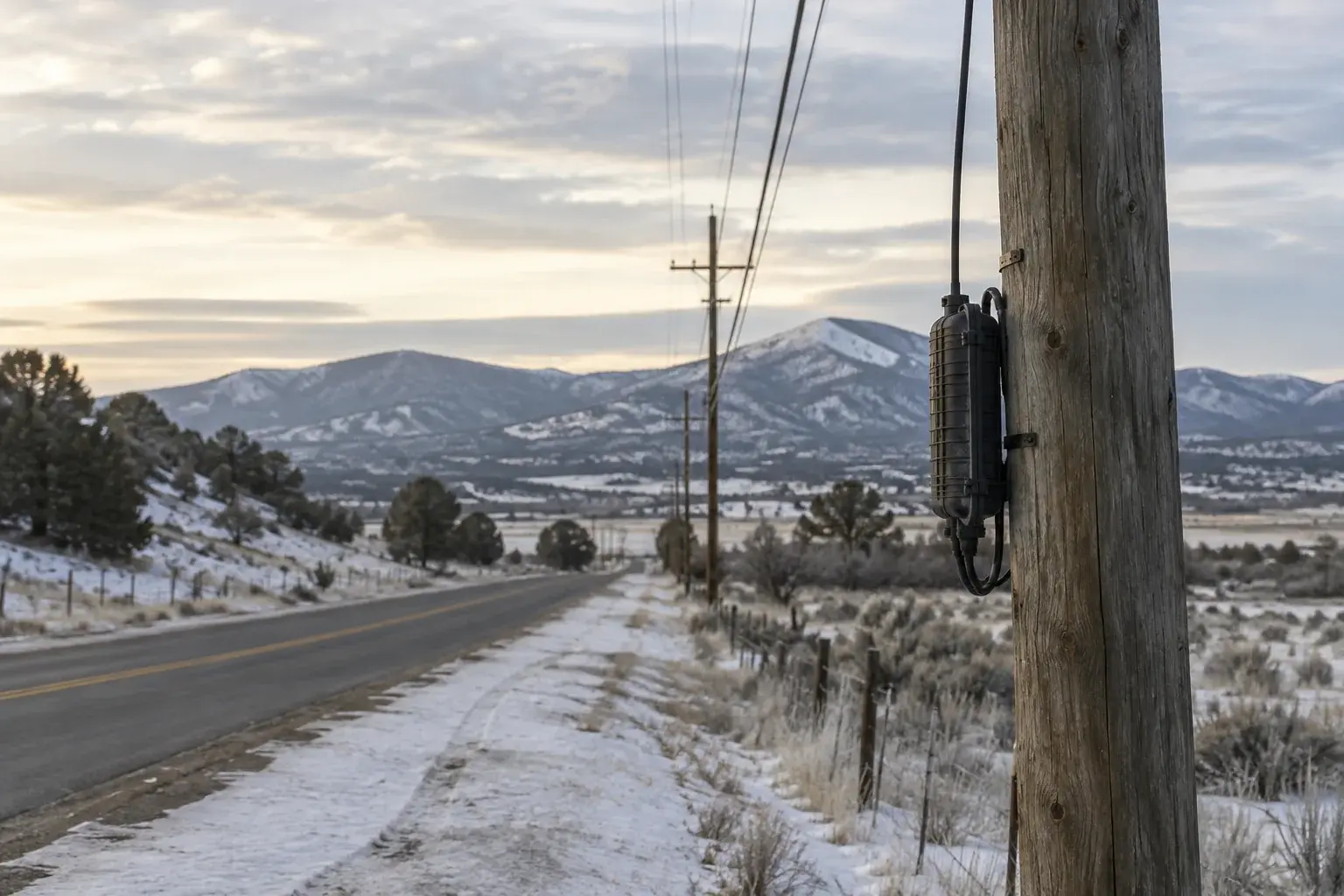
Colorado's broadband push looks like a construction story. Crews, fiber spools, trenching machines, splice crews working through the night. It is actually a right-of-way story, and the right-of-way work starts long before anyone breaks ground. As the state races toward its federally funded broadband goals, agencies, internet service providers, and landowners are running into the same easements, permits, and pole attachment questions that have shaped every other kind of utility corridor in Colorado. This post walks through how fiber and broadband right-of-way actually works here, what the current BEAD-funded buildout means for the next few years, and what property owners and project managers should expect along the way.
Quick Summary
Why Colorado's Broadband Buildout Is Also a Right-of-Way Project
Every mile of new fiber needs a legal path to follow, whether that is buried conduit under a county road, a strand hung on an existing utility pole, or a trench cut across a rancher's back forty. That legal path is right-of-way, and securing it is often the slowest part of a broadband project, not the fastest.
Engineering a fiber route is relatively quick work for an experienced designer. Negotiating access to every parcel, pole, and public right-of-way segment along that route is not. In our experience, utilities and internet service providers that treat right-of-way as an afterthought tend to discover the problem only after construction crews are mobilized and waiting on an easement that has not closed.
What Is BEAD and Why Is Colorado Moving So Fast?
The Broadband Equity, Access and Deployment (BEAD) program is a federal grant program created to help close the broadband gap in areas that internet service providers have historically passed over, mostly rural and mountain communities. Colorado has been allocated more than $826 million in BEAD funding, and the state has set a goal of connecting more than 99% of homes to reliable broadband by early 2027.
That is an aggressive timeline for a state with Colorado's terrain and land ownership patterns. Mountain corridors, large ranch and agricultural parcels, federal and tribal land, and a patchwork of county and municipal jurisdictions all add friction to a buildout schedule. In practice, that means right-of-way and easement work has to move in parallel with engineering and construction, not after it, if the state's connectivity target is going to be realistic.
Where Fiber Right-of-Way Actually Comes From
Broadband right-of-way is rarely a single negotiation. A typical route stitches together several different kinds of authorization, each with its own process and timeline.
Public Right-of-Way and the CDOT Dig Once Program
Colorado's Department of Transportation runs a Dig Once program under C.R.S. § 38-5.5-109 and the federal MOBILE NOW Act of 2018. The idea is straightforward: when CDOT has a highway project planned that involves opening the ground, it notifies broadband providers and other interested parties so they can install conduit at the same time, rather than trenching the same corridor twice.
CDOT maintains a notification list and an online dashboard for these opportunities, and it encourages providers to put a Master Service Agreement or Intergovernmental Agreement in place ahead of time. According to CDOT's own program materials, having that kind of agreement already executed can cut the time needed to finalize a specific project from well over a year down to a matter of weeks. Providers without an existing agreement in place should plan for a significantly longer runway.
Pole Attachments and Joint Use Agreements
Where fiber runs aerially, it usually attaches to poles that already belong to an electric utility, a telephone company, or a municipal pole owner. Getting on those poles requires a pole attachment or joint use agreement, along with a make ready process to confirm the pole has room and meets safety clearance requirements before a new line is added.
Make ready work can become its own bottleneck. A pole that needs to be replaced or has other attachers ahead of it in the queue can add months to a segment that otherwise looked simple on a map. We generally recommend ordering make ready studies as early as possible, well before construction crews are scheduled.
Private Easements on Agricultural and Rural Land
Once a route leaves public right-of-way and existing pole lines, it typically needs a private easement. This is where broadband right-of-way starts to look like any other utility easement acquisition: identifying the parcel owner, confirming title, presenting terms, and negotiating compensation and the scope of the easement.
Rural and agricultural landowners are often asked for narrow, permanent easements for buried conduit, sometimes paired with a temporary construction easement for the trenching work itself. The price is paid once. The easement language lasts. The permanent easement typically carries a one-time payment, while the temporary easement should come with clear restoration terms for any disturbed land. Our agents walk every one of these terms through with the landowner before anyone signs.
Aerial vs. Underground Fiber: How the Route Decision Shapes the Right-of-Way Work
Whether a segment goes aerial or underground is usually an engineering and cost decision, but it has real consequences for the right-of-way process behind it.
FactorAerial FiberUnderground FiberPrimary authorization neededPole attachment or joint use agreementEasement or public right-of-way permitTypical paceOften faster where pole capacity already existsOften slower due to excavation permitting and easement negotiationKey riskMake ready delays and pole replacement costsUtility locates, soil conditions, and landowner negotiationVisual and land impactMinimal ground disturbanceTemporary surface disruption, generally less visible once restoredCommon settingEstablished utility corridors and town centersRural routes, agricultural land, and new subdivisions
How Broadband Right-of-Way Acquisition Typically Works
While every project has its own wrinkles, broadband right-of-way acquisition generally follows a consistent sequence.
What This Means for Agencies, Utilities, and Project Managers
For public agencies and internet service providers chasing BEAD deadlines, the lesson is simple. Right-of-way work needs its own project timeline, its own budget line, and its own point of accountability. Treating it as a line item inside the construction schedule is how fiber projects end up with crews mobilized and nowhere to go.
Municipal franchise agreements deserve particular attention. A city or county's permitting process for broadband work in its own rights-of-way can involve its own application, fee schedule, and review timeline, separate from anything CDOT or a pole owner requires. Projects that cross multiple jurisdictions should expect to manage several parallel permitting tracks at once, each on its own clock.
Projects funded in whole or in part with federal dollars can also carry additional real property compliance obligations layered on top of ordinary state and local requirements. It is worth confirming early, with legal counsel or a grant administrator, exactly which rules apply to a given funding source before acquisition work begins.
What Landowners Should Expect When a Fiber Project Crosses Their Property
If a broadband provider or its right-of-way agent contacts a landowner about a fiber easement, a few things are worth knowing going in. An easement request is a negotiation, not a formality. Landowners are entitled to understand exactly what rights are being requested, how wide the permanent and any temporary easement will be, what compensation is being offered, and what restoration the provider is responsible for once construction wraps up.
It is reasonable to ask for time to review an offer, to ask questions about the route and the work involved, and to consult an attorney, particularly for a larger or more complex easement. Most fiber easements are modest in scope compared to a transmission line or pipeline corridor, but modest does not mean the landowner has less of a say in the terms.
Quick Answer: What Is Right-of-Way in a Broadband Project?
Right-of-way in a broadband project is the legal authorization to install and maintain fiber infrastructure along a given route, whether that authorization comes from a public agency for work in a street or highway corridor, from a pole owner through an attachment agreement, or from a private landowner through an easement. Without securing each of these in sequence along the route, construction cannot legally proceed, no matter how complete the engineering design is.
Key Takeaways
The Bottom Line for Colorado Broadband Projects
Colorado's broadband goals are ambitious, and the money is now in place to chase them. What will decide whether individual projects hit their in-service dates is not the fiber itself. It is whether the right-of-way work, across public corridors, utility poles, and private land, gets the early attention and dedicated management it needs.
For agencies and providers planning BEAD-funded work, the practical next step is to build a right-of-way schedule alongside the engineering schedule, not after it, and to bring in experienced right-of-way support early enough to flag pole, title, and easement issues before they become construction delays. For landowners who have been contacted about a fiber easement, the next step is simpler: ask questions, take the time you need, and get the terms in writing before you sign.
This post describes general right-of-way and permitting concepts and is not legal advice. Specific situations, especially those involving compensation disputes or unclear title, should be discussed with a qualified attorney.
If you are planning a broadband project in Colorado, or you have been contacted about a fiber easement and want a second set of eyes on the terms, we are happy to talk it through. No obligation and no agenda, just a conversation.
Frequently Asked Questions
Does a broadband or fiber company have the right to put a line across my property without my permission?
No. A private company generally cannot install fiber across private land without either an easement granted by the landowner or another legal right to be there, such as an existing utility corridor. If you are contacted about a fiber easement, you are entitled to review and negotiate the terms before agreeing to anything.
What is the CDOT Dig Once program?
CDOT's Dig Once program, authorized under C.R.S. § 38-5.5-109 and the federal MOBILE NOW Act of 2018, coordinates broadband conduit installation with planned state highway construction so that a road corridor is not excavated multiple times for separate projects. Providers can subscribe to notifications and track opportunities through CDOT's online dashboard.
How much is a fiber or broadband easement worth?
Easement compensation depends on factors like the width and length of the easement, the type of land affected, and local market conditions, so there is no single figure that applies everywhere. A landowner offered an easement should feel free to ask how the offer was calculated and to seek an independent opinion if the compensation seems unclear.
Why is broadband right-of-way different from a typical utility easement?
The underlying legal concepts are similar, but broadband projects more often combine three distinct types of authorization, public right-of-way, pole attachments, and private easements, within a single route. That mix, along with aggressive federal funding deadlines, makes coordination across agencies and property owners especially important.
How long does it take to secure right-of-way for a fiber project in Colorado?
Timelines vary widely depending on the mix of public right-of-way, pole attachments, and private easements involved. Public right-of-way through CDOT can move in a matter of weeks when a Master Service Agreement is already in place, or well over a year without one. Private easement negotiations and pole make ready work each add their own timeline, which is why early planning matters more than almost any other factor.
Frequently Asked Questions
Have questions about our sustainability initiatives, eco-friendly practices, or how you can make a positive impact?
Western States Land Services is headquartered in Loveland, Colorado. We primarily serve Colorado, Wyoming, Nebraska, Kansas, New Mexico, Utah, and Texas, with experience working on projects across the broader Mountain West.
Western States Land Services was founded in 1981. The firm has been providing right-of-way acquisition, relocation, and permitting services in Colorado and the Mountain West for more than 45 years. Our team carries more than 150 years of combined industry experience.
Yes. Western States Land Services is prequalified with the Colorado Department of Transportation (CDOT) for right-of-way services. The firm is also experienced in FHWA requirements and fully compliant with the Uniform Relocation Assistance and Real Property Acquisitions Policies Act for federally regulated projects.
We serve public agencies, municipal governments, state departments of transportation, investor-owned utilities, oil and gas companies, pipeline operators, and private infrastructure developers. We have delivered right-of-way services across every sector — from CDOT highway corridors and utility transmission lines to rural pipeline routes and municipal capital improvement projects.
We offer the staffing capacity of a large firm with the direct access and personal accountability of a specialized boutique. Clients work with senior leadership — not a call center. Our agents meet landowners face-to-face. Our regulatory knowledge is deep rather than generalized. We have never needed to ramp up on Colorado or Mountain West rules. We have been working inside them for over 40 years.
Yes. Western States Land Services has experience supporting eminent domain proceedings, including preparing waiver valuations, providing expert witness testimony, and coordinating with legal counsel throughout the condemnation process. Our team has worked alongside attorneys on both agency-initiated and privately sponsored condemnation actions across Colorado.
